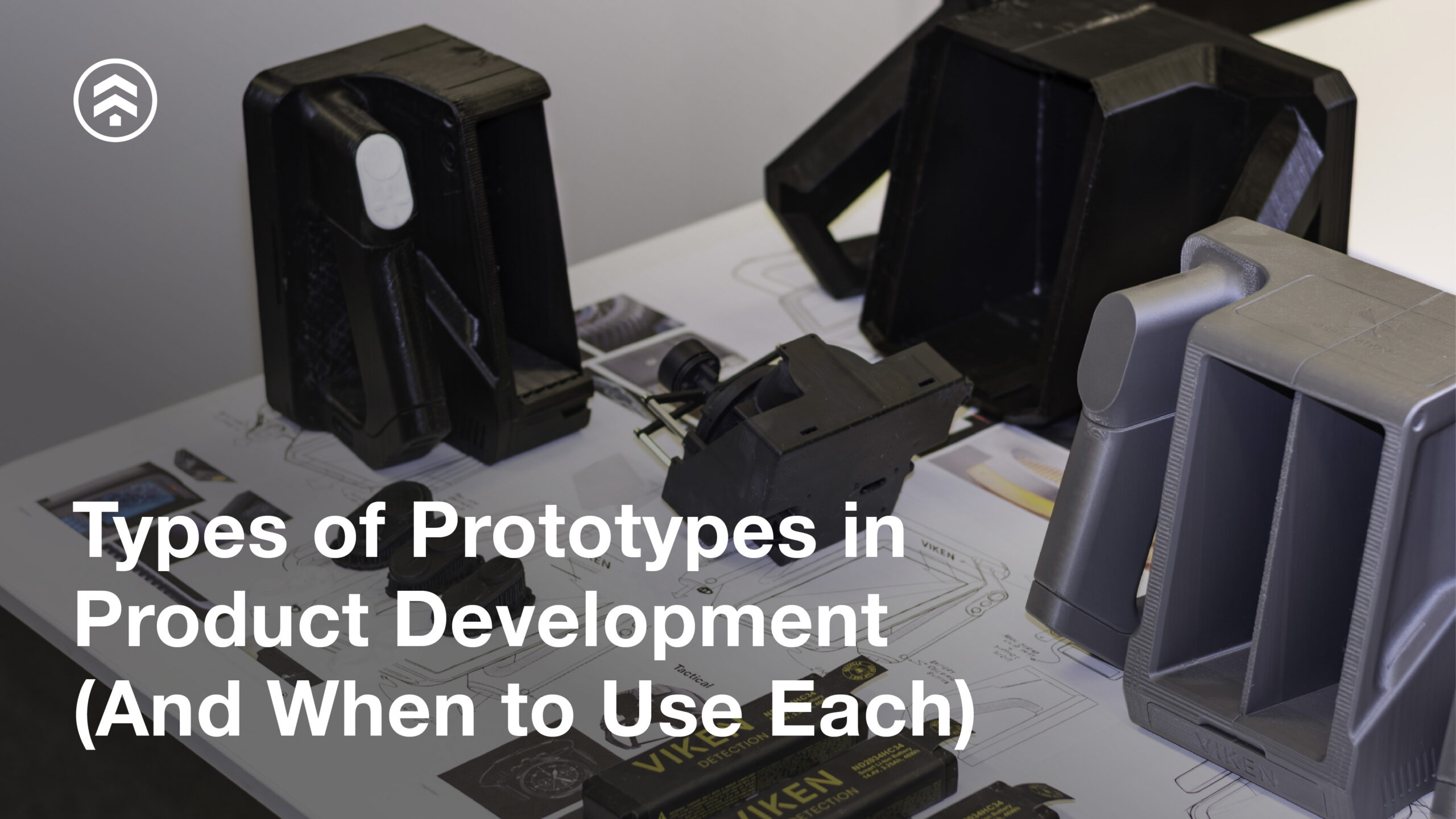
Most successful product development programs use multiple forms of prototyping before production, each designed to answer a different question. The challenge is not simply deciding when to build a prototype. It is determining what you need to learn, then building the lowest-cost, lowest-fidelity prototype capable of answering that question.
A sketch may be enough to compare early ideas. A foam model may answer an ergonomic question. A functional prototype may expose a mechanical problem before tooling is built. As development progresses, EVT, DVT, and PVT builds progressively reduce engineering, product, and manufacturing risk.
Choosing the right prototype at the right stage reduces risk, accelerates development, improves collaboration, and prevents costly design changes later in the process.
In this guide, Matthew Bettencourt, Director of Industrial Design at Sprout Studios, breaks down the most common types of prototypes used throughout product development, explains when each should be used, and explores how digital tools, rapid prototyping, and AI are changing the way companies bring products to market.
What Is A Prototype?
A prototype is a representation of a product, experience, component, or system created to answer a specific question before committing to the next level of development.
Not every prototype looks or functions like the finished product. Some exist only as sketches or digital 3D models, while others are fully functional engineering samples built to test performance, manufacturing, or usability.
Rather than treating prototyping as a single milestone, successful product development teams use prototypes throughout the design process to answer specific questions, reduce uncertainty, and validate decisions before making significant investments.
The goal of prototyping is not to make something. It is to learn something.
How To Choose The Right Prototype At The Right Time
The best prototype is the one that answers the next important question.
Early in product development, simple sketches or digital concept models help teams explore ideas, compare design directions, and align stakeholders before investing in engineering. As confidence in the design grows, prototypes become increasingly detailed, allowing teams to validate ergonomics, functionality, engineering performance, and manufacturing readiness.
Rather than trying to answer every question with a single prototype, successful development programs use multiple prototypes throughout the process. Each one builds on the last, reducing uncertainty and providing the information needed to make informed decisions before moving forward.
When selecting a prototype, consider questions such as:
- What decision are we trying to make?
- Who will be evaluating the prototype?
- Does it need to look realistic, function realistically, or both?
- What level of fidelity is necessary to answer our questions?
- Are we validating the product, the user experience, or the manufacturing process?
- What happens if this assumption is wrong?
- What is the cheapest way to answer this question reliably?
- Does this prototype need to validate one subsystem or the complete product?
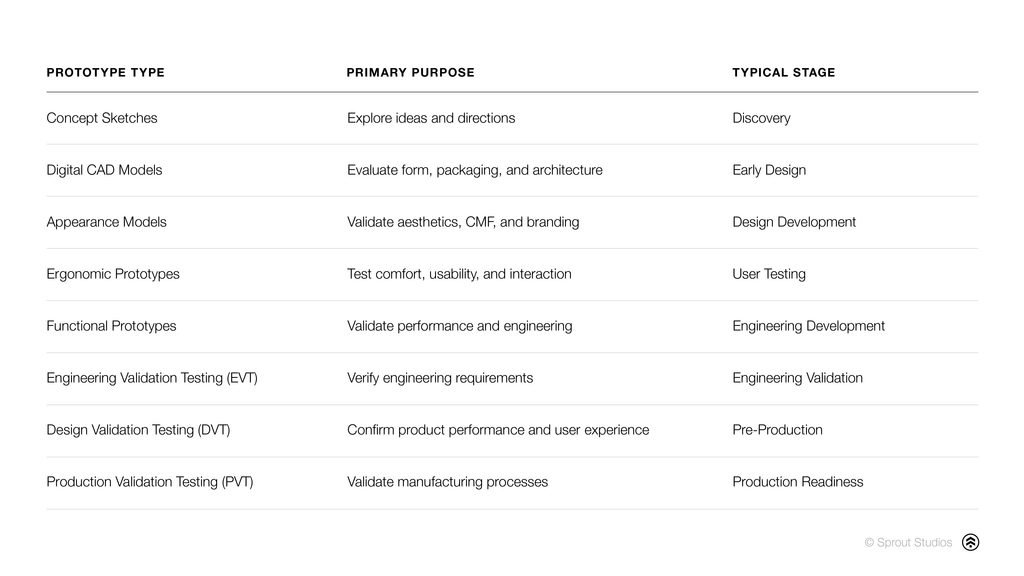
Types Of Prototypes At A Glance
Different prototypes answer different questions. The most effective product development programs progressively increase the fidelity of prototypes as confidence in the design grows.
While every project follows a different path, these prototype types represent the progression most teams move through as a product evolves from concept to production.
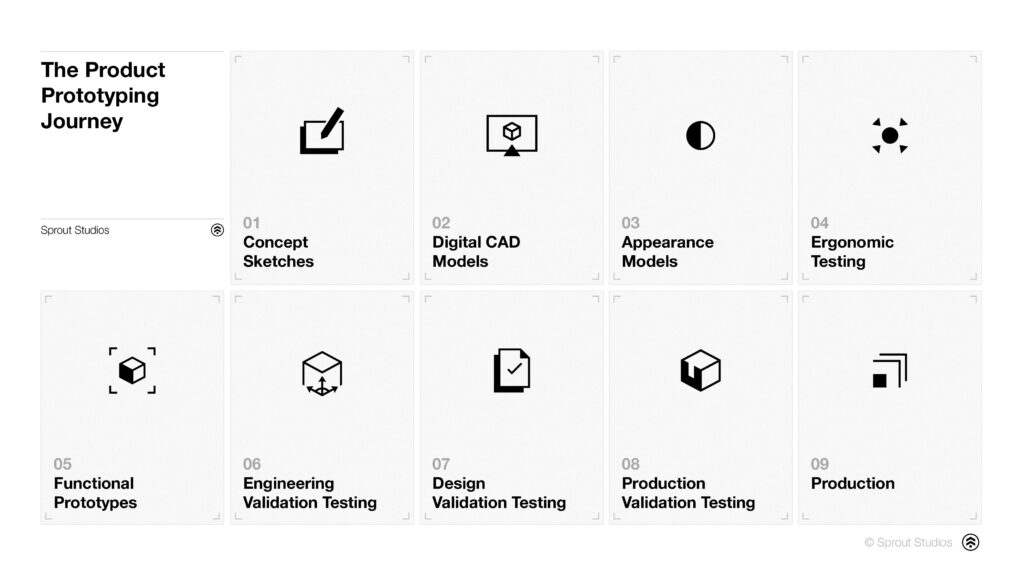
Types Of Prototypes Used In Product Development
Prototyping isn’t a single event. It’s a continuous process of reducing uncertainty.
Early in development, prototypes help teams determine whether they’re solving the right problem and pursuing the right design direction. As the product matures, prototypes become increasingly detailed and realistic, validating engineering performance, manufacturing feasibility, and user experience before production begins.
Prototype fidelity generally increases as development progresses, but these activities often overlap and repeat rather than occurring in a perfectly linear sequence.
Each stage builds confidence before the next investment is made.
Instead of asking every question at once, teams progressively validate assumptions throughout development.
Early prototypes answer questions like:
- Is this the right problem to solve?
- Does this concept meet user needs?
- Which design direction shows the most promise?
As development progresses, the focus shifts toward execution:
- Can this product be manufactured efficiently?
- Will it perform reliably under real-world conditions?
- Do the materials, finishes, and assembly methods meet production requirements?
- Is the design ready for full-scale manufacturing?
By matching the prototype to the decision being made, companies avoid unnecessary costs, shorten development timelines, and identify potential issues before they become expensive to fix.
The following sections explore each type of prototype in more detail, including when it should be used and the value it brings to the product development process.
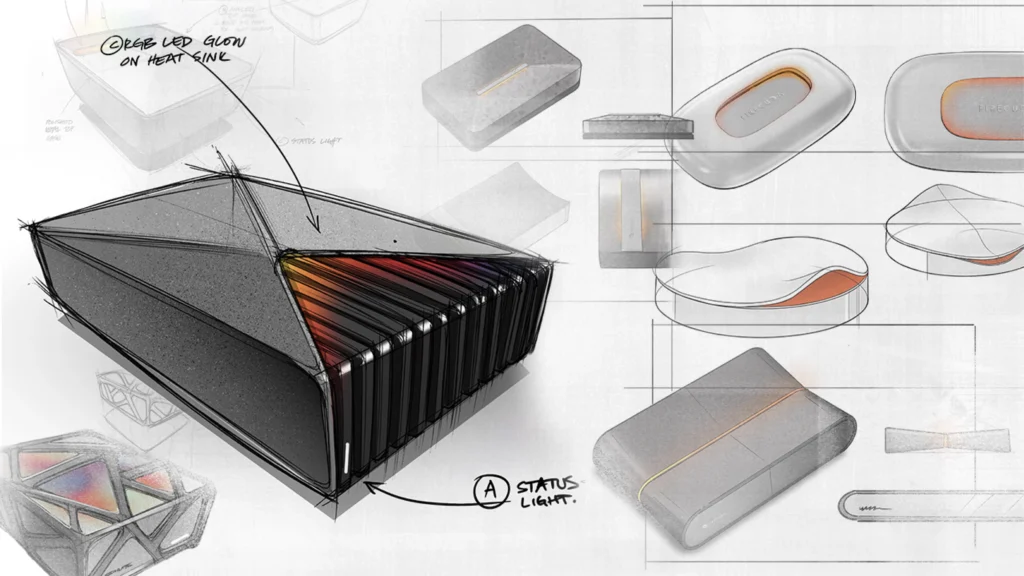
Concept Sketches
Concept sketches are the earliest form of prototype, used to explore and compare ideas before any detailed modeling or engineering begins. Early ideas should be inexpensive to explore and easy to discard. Sketches allow teams to compare many possible directions before investing in detailed CAD, engineering, or physical prototypes.
Unlike later-stage prototypes, sketches aren’t intended to be polished or technically accurate. Their purpose is to generate ideas quickly, compare different approaches, and identify promising directions before investing time in detailed modeling or engineering.
Because sketches are inexpensive to create and easy to revise, they encourage creative exploration without the cost of physical prototypes or CAD development. Teams can evaluate multiple concepts side by side, gather stakeholder feedback early, and eliminate weaker ideas before additional resources are committed.
Concept sketches are commonly used to:
- Brainstorm product ideas
- Compare multiple design directions
- Facilitate stakeholder discussions
- Explore product form and user interaction
- Align cross-functional teams early in development
Their value comes from keeping the cost of being wrong extremely low. Weak directions can be discarded quickly, while stronger ideas earn additional development investment.
AI-Assisted Concept Prototypes
AI-assisted visualization can help teams explore a wider range of visual directions before investing in detailed CAD or physical models. These outputs are most useful during divergent exploration, where speed and breadth matter more than dimensional accuracy or engineering feasibility.
AI-assisted concepts can help teams:
- Explore visual directions quickly
- Compare form, CMF, and contextual ideas
- Build stimulus for customer research
- Communicate early concepts to stakeholders
- Expand the range of ideas considered before convergence
These outputs should not be confused with engineering prototypes. Their value is speed, communication, and exploration rather than dimensional or technical validation.
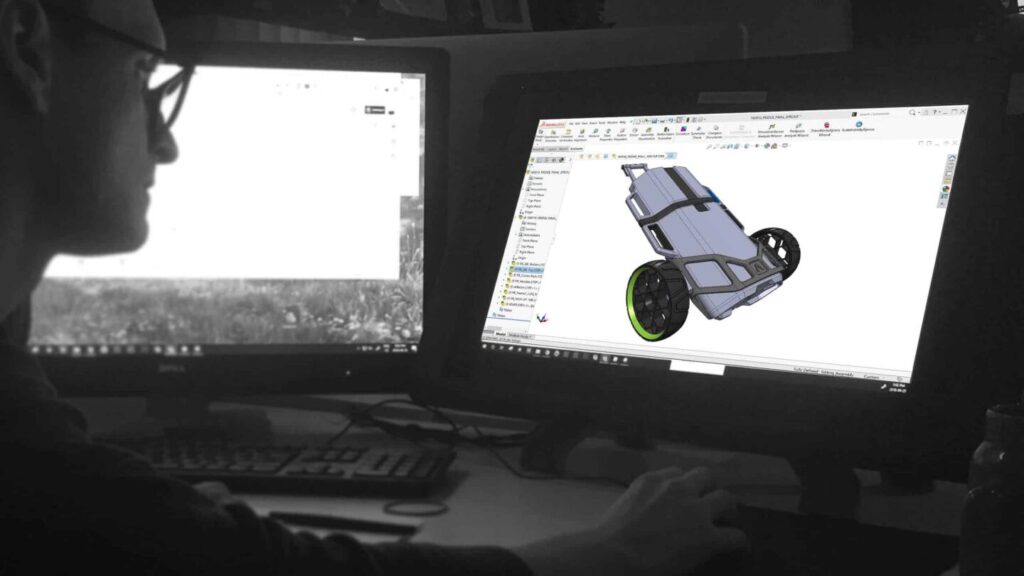
Digital CAD Prototypes
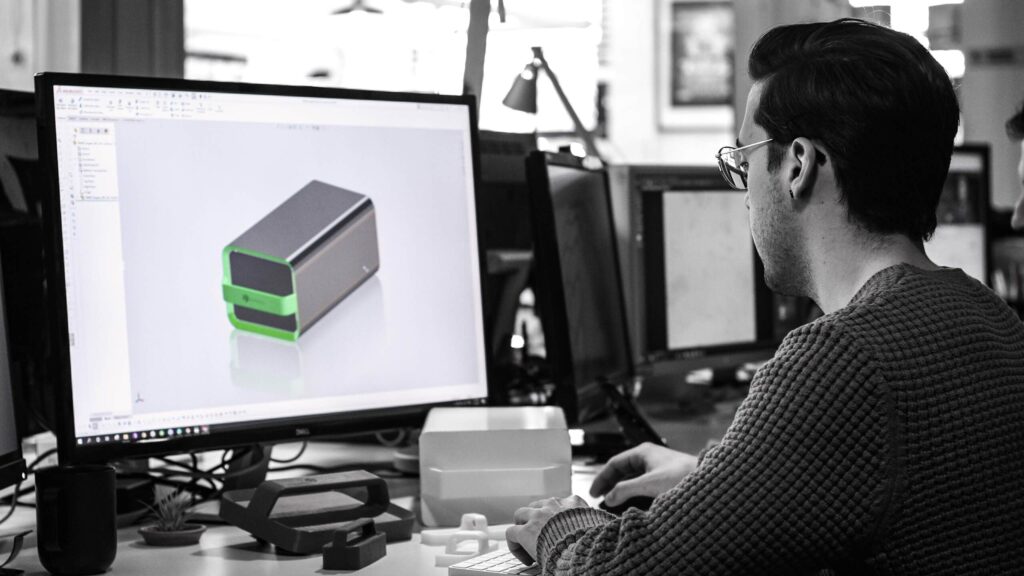
Once a direction merits further development, CAD allows teams to translate an idea into controlled three-dimensional geometry that can be measured, reviewed, revised, rendered, simulated, and eventually fabricated.
Digital concept models allow designers and engineers to evaluate the product long before a physical prototype exists. Teams can refine proportions, ergonomics, internal architecture, packaging constraints, and component layouts while making changes in minutes rather than days.
Beyond visualization, CAD models become the foundation for engineering collaboration. Industrial designers, mechanical engineers, marketing teams, manufacturers, and clients can all review the same digital model, reducing interpretation errors and improving decision-making throughout the development process.
Modern CAD workflows also support simulation, rendering, and rapid prototyping, allowing teams to validate ideas digitally before investing in physical builds.
Digital concept models help teams evaluate:
- Overall product form and proportions
- Ergonomics and user interaction
- Internal component layouts
- Packaging and space constraints
- Assembly concepts
- Design feasibility before prototyping
As products mature, controlled CAD data becomes an increasingly important reference connecting industrial design, engineering, prototyping, visualization, and manufacturing.
Appearance Models And Visual Prototypes
Appearance prototypes are used to evaluate how a product should look and feel without requiring every underlying system to function. Depending on the question being answered, they may take the form of a highly finished physical model, photorealistic CGI, or both.
Appearance models are especially valuable when gathering executive approvals, conducting customer research, presenting to investors, preparing retail reviews, or capturing marketing photography.
CGI can provide a high-fidelity visual prototype before production-intent hardware exists. Teams can evaluate proportion, CMF, branding, context, and portfolio relationships while engineering continues in parallel. In some cases, the same digital assets can later support research, internal approvals, or launch content.
Appearance prototypes are commonly used to evaluate:
- Color, materials, and finishes (CMF)
- Product proportions
- Brand integration
- Packaging interaction
- Retail presentation
- Overall visual appeal
By separating visual evaluation from engineering validation, appearance models allow teams to refine the customer experience without delaying technical development.
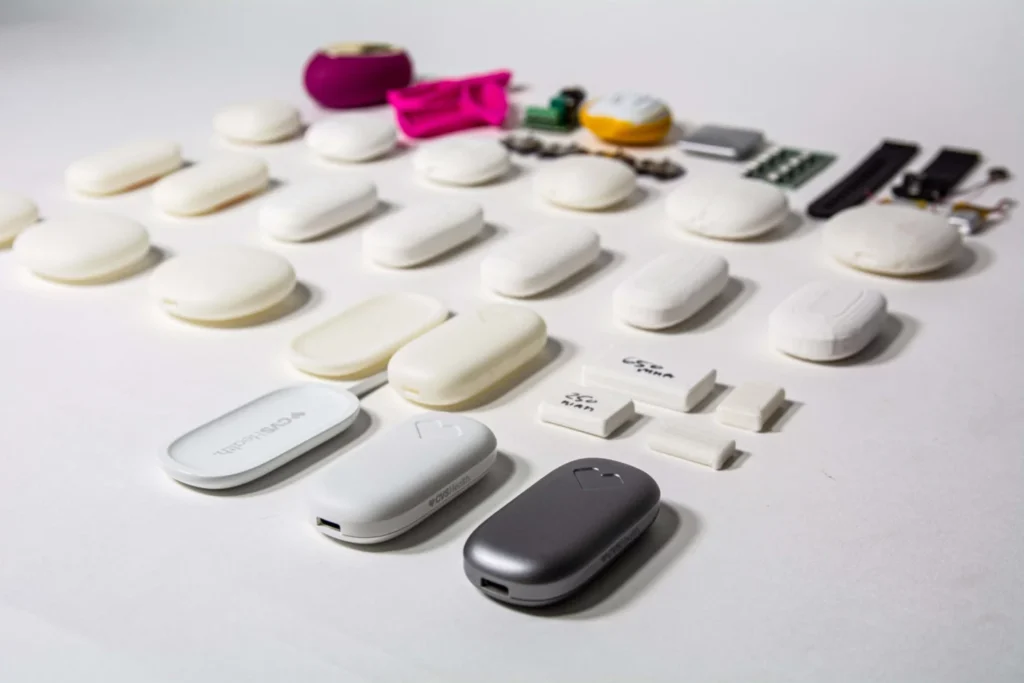
Ergonomic And User Testing Prototypes
Ergonomic prototypes are built to evaluate how users naturally interact with a product before engineering decisions become difficult or expensive to change. Some questions cannot be answered on a screen. Grip, reach, balance, comfort, access, and physical interaction often need to be experienced directly.
A product may meet every engineering requirement on paper while still feeling awkward, unintuitive, or uncomfortable in real-world use. Observing users interact with an early prototype often reveals friction that CAD models alone cannot predict.
These prototypes don’t need to be highly refined. Depending on the objective, they may be created using foam models, CNC machining, urethane casting, or rapid 3D printing, allowing teams to test ideas quickly and iterate based on user feedback.
Ergonomic prototypes help evaluate:
- Comfort
- Grip and hand positioning
- Reach and accessibility
- Scale and anthropometric fit
- Balance and weight distribution
- Ease of use
- User interaction
Early usability testing helps identify issues before they become costly engineering changes, resulting in products that are both technically sound and enjoyable to use.
Functional Prototypes
Functional prototypes isolate and test the systems that determine whether the product can work as intended. They validate engineering systems, mechanical assemblies, electronics, moving components, and overall performance under realistic conditions. At this stage, the focus shifts from appearance to function.
A functional prototype does not always need to look like the finished product. In many cases, separating function from appearance allows teams to test mechanisms, electronics, thermal behavior, or assemblies faster and at lower cost.
Unlike appearance models, these prototypes prioritize function over aesthetics. They often combine production-intent components with temporary materials or unfinished housings, allowing engineering teams to validate critical systems before committing to tooling.
Functional testing frequently uncovers interactions between components that are difficult to predict digitally. Issues involving mechanisms, tolerances, electronics, thermal performance, assembly sequences, or durability often become apparent only after a working prototype is built.
Discovering these challenges early helps prevent expensive redesigns later in the product development process.
Functional prototypes are commonly used to validate:
- Mechanical systems
- Electronics integration
- Moving components
- Durability
- Thermal performance
- Assembly methods
- User interaction
- Overall product performance
Building a functional prototype doesn’t mean the design is complete. It means the team has reached a point where performance can be tested, refined, and validated before entering formal engineering validation.
Engineering Validation Prototypes (EVT)
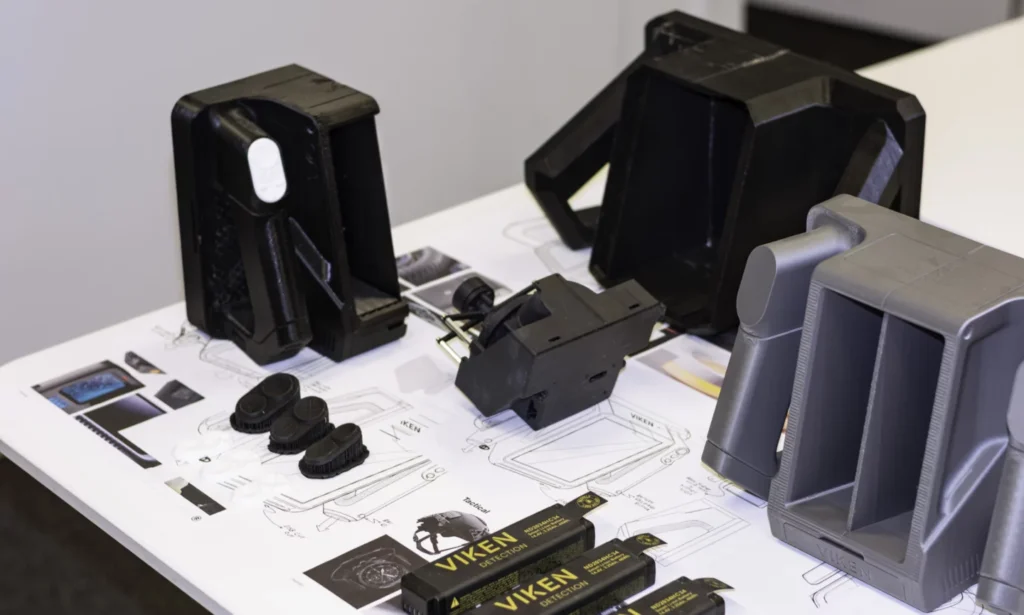
Engineering Validation Testing (EVT) is typically an early formal validation stage used to determine whether the engineering architecture and major subsystems can meet the product’s technical requirements.
By EVT, the architecture is generally mature enough for teams to evaluate mechanical performance, subsystem integration, dimensional accuracy, tolerances, and technical feasibility in a more disciplined way.
EVT prototypes are commonly used to verify:
- Mechanical performance
- Dimensional accuracy
- Component fit and tolerances
- Engineering requirements
- Electronics integration
- Subsystem functionality
Engineering validation frequently uncovers issues that weren’t apparent during earlier functional testing. Small changes to part geometry, tolerances, or component interactions can have significant effects once multiple systems begin working together.
Resolving these challenges during EVT helps avoid costly redesigns later in the development process.
Design Validation Testing (DVT)
Design Validation Testing (DVT) confirms that the complete product performs reliably under real-world conditions and closely reflects the final production design. DVT shifts the emphasis from proving the engineering architecture toward validating the complete, production-intent design against product requirements, user expectations, compliance needs, and real-world conditions.
By this stage, prototypes often look and function almost identically to the products customers will ultimately receive.
Testing requirements vary by industry and application but commonly include environmental testing, durability testing, compliance verification, and cosmetic evaluation.
DVT prototypes may be used for:
- Environmental testing
- Drop and impact testing
- Regulatory compliance
- Long-term durability
- Cosmetic evaluation
- Packaging validation
- User acceptance testing
Because DVT prototypes closely resemble production units, they also provide an opportunity for cross-functional teams to evaluate the product before launch.
Successful DVT builds confidence that both the design intent and customer experience have been achieved before manufacturing begins.
Production Validation Testing (PVT)
Production Validation Testing (PVT) asks a different question: can the intended manufacturing process repeatedly build the product at the required quality, rate, and cost? Even a well-designed product can encounter unexpected challenges once it reaches the factory floor, which is exactly what this stage is built to catch.
These prototypes are typically produced using production-intent tooling, assembly methods, equipment, and manufacturing workflows, providing the closest representation of full-scale manufacturing before mass production begins.
Production validation commonly evaluates:
- Production tooling
- Assembly procedures
- Manufacturing repeatability
- Quality control processes
- Production yields
- Packaging operations
- Inspection procedures
PVT often reveals opportunities to improve assembly efficiency, reduce quality variation, or streamline manufacturing before production volumes increase.
Completing production validation successfully gives teams confidence that both the product and the manufacturing process are ready for launch.
Accelerating Product Development With Rapid Prototyping
Product development teams rarely rely on a single prototyping method.
Instead, they combine multiple rapid prototyping techniques to evaluate ideas quickly, shorten development timelines, and reduce overall project risk.
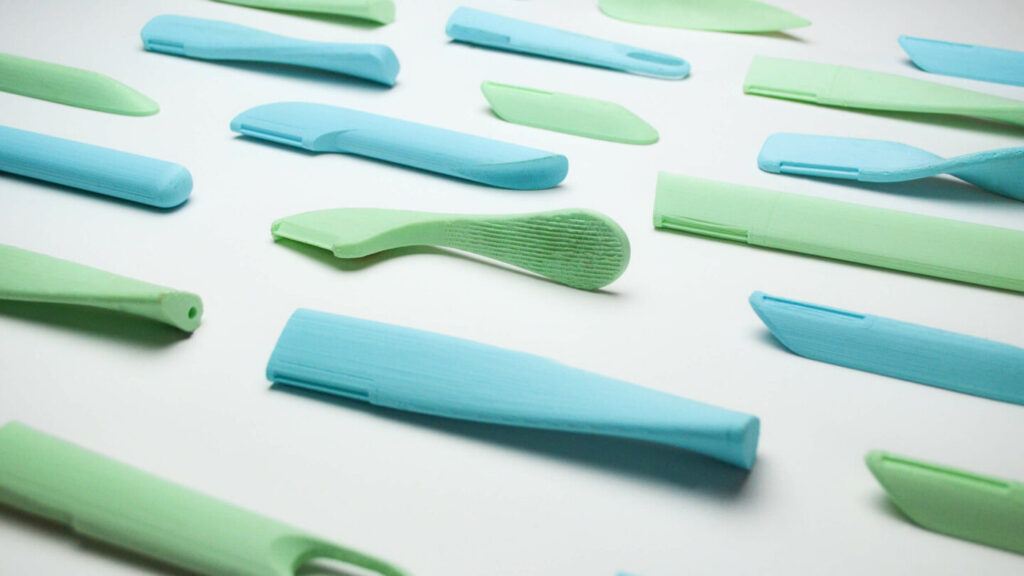
Rapid prototyping uses fast, relatively low-investment fabrication methods to turn digital designs into physical learning tools without committing to full production tooling. Depending on the project, different methods may be selected based on speed, accuracy, material requirements, and cost.
Common rapid prototyping methods include:
- 3D printing
- CNC machining
- Urethane casting
- Vacuum forming
- Laser cutting
- Soft tooling
Each process offers unique advantages. A simple ergonomic model may be produced overnight using 3D printing, while CNC machining may be preferred when evaluating production materials or precision tolerances. Choosing the right prototyping method depends on what the team is trying to learn, not simply how quickly a prototype can be produced.
Rapid prototyping is integrated throughout the product development process at Sprout. Our in-house model shop enables us to quickly produce and refine prototypes for design reviews, ergonomic evaluations, and functional testing, allowing ideas to be validated and iterated without unnecessary delays. When projects require specialized processes or production-intent manufacturing methods, we also leverage a trusted network of prototyping partners to deliver the right solution for each stage of development.
When combined with digital design tools, rapid prototyping enables faster iteration cycles, earlier testing, and more informed design decisions throughout the product development process.
Physical Vs. Digital Prototypes
Digital and physical prototypes answer different questions, and the strongest product development programs use both throughout the process.
Digital prototypes are especially useful when teams need to explore ideas quickly, compare design directions, evaluate product architecture, review proportions, develop CMF, run simulations, or align stakeholders before committing to physical builds. CAD models, photorealistic renderings, simulation tools, and AI-assisted workflows allow teams to make changes rapidly and evaluate a broader range of possibilities at relatively low cost.
Digital prototypes are particularly effective for:
- Exploring and comparing design concepts
- Evaluating form, proportions, and product architecture
- Reviewing component layouts and packaging constraints
- Exploring color, materials, and finishes
- Supporting engineering simulation and analysis
- Creating realistic visuals for stakeholder or customer research
- Developing marketing assets before production
Physical prototypes become essential when the question depends on real-world interaction or material behavior. Grip, weight, balance, tactile quality, mechanisms, durability, assembly, and manufacturing performance cannot always be predicted accurately on a screen.
Physical prototypes are particularly effective for:
- Ergonomic and usability testing
- Evaluating grip, reach, balance, and comfort
- Testing mechanical systems and moving components
- Validating material properties and tactile qualities
- Assessing assembly methods and tolerances
- Durability and environmental testing
- Manufacturing and production validation
The decision is not whether to use a digital or physical prototype. It is which method can answer the current question with the least unnecessary investment.
We move between digital and physical prototyping as the product develops. Digital workflows allow our teams to explore broadly, align quickly, and identify issues before fabrication. As the design matures, physical prototypes validate the characteristics that must be experienced, tested, or manufactured in the real world.
In many cases, the two work together. A CAD model may be used to create a 3D-printed ergonomic prototype, feedback from that model may drive another CAD iteration, and the revised digital model may then support functional testing or a higher-fidelity prototype.
Rather than treating digital and physical prototyping as separate phases, we use them as complementary tools for progressively reducing uncertainty. The objective is always the same: learn what needs to be learned before committing to the next level of development.
Matching the prototype to the objective allows teams to control costs, shorten development timelines, and avoid unnecessary iterations.
Frequently Asked Questions
What is the difference between a prototype and a proof of concept?
A proof of concept (POC) is created to determine whether an idea or technology is feasible. A prototype goes a step further by evaluating how a product looks, functions, or will be manufactured. A proof of concept primarily asks, “Can this principle or technology work?” A prototype can answer a much broader range of questions about form, interaction, function, engineering, and manufacturing.
What is rapid prototyping?
Rapid prototyping is the process of quickly creating physical models using methods such as 3D printing, CNC machining, urethane casting, or vacuum forming. These techniques allow product teams to test ideas, gather feedback, and refine designs much faster than traditional manufacturing methods.
What is the difference between EVT, DVT, and PVT?
These three stages represent key milestones in preparing a product for manufacturing:
- Engineering Validation Testing (EVT): Verifies that the product meets engineering and technical requirements.
- Design Validation Testing (DVT): Confirms that the complete product performs as intended and delivers the desired user experience.
- Production Validation Testing (PVT): Ensures the manufacturing process can consistently produce the product at the required quality.
Together, these validation stages help reduce risk before full-scale production begins.
Can 3D printing replace traditional prototyping?
3D printing is one of the most common rapid prototyping methods, but it doesn’t replace every type of prototype. Depending on the project, CNC machining, urethane casting, soft tooling, or production-intent manufacturing processes may be more appropriate. The best method depends on what you’re trying to evaluate.
How many prototypes are typically built before production?
There isn’t a standard number. Most products go through multiple rounds of prototypes, each designed to answer different questions throughout development. Simple consumer products may require only a handful of iterations, while complex medical devices or industrial equipment may go through numerous design, engineering, and manufacturing validation builds before production.
How much does a prototype cost?
Prototype costs vary widely depending on the product’s complexity, size, materials, and manufacturing process. Costs can range from inexpensive sketches and simple mockups to substantial investments in production-intent engineering builds. Complexity, size, materials, quantity, fidelity, and fabrication method all affect cost. The goal is to invest in the right prototype at the right time to reduce overall development risk.
Can digital prototypes replace physical prototypes?
Digital prototypes have transformed product development by allowing teams to evaluate concepts, collaborate remotely, and identify issues earlier than ever before. However, physical prototypes remain essential for validating ergonomics, tactile quality, durability, assembly, and real-world user interactions. The most successful development programs combine both digital and physical prototyping throughout the design process.
Prototyping Is A Strategy, Not A Step
Prototyping is fundamentally a risk-management strategy. Each prototype should retire a specific uncertainty before the team commits more time, engineering effort, tooling, or capital to the product.
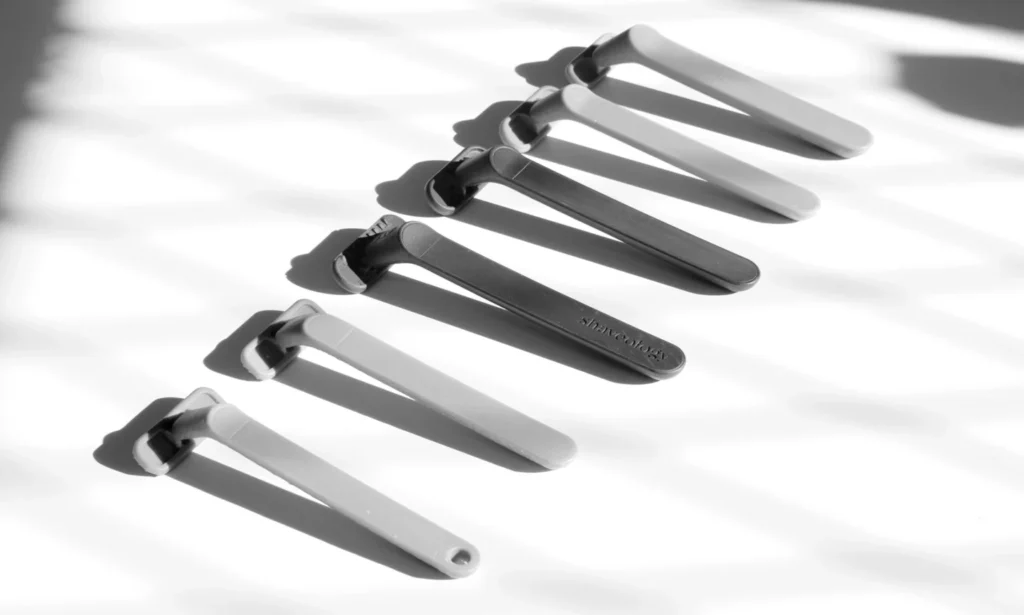
Discovering a grip problem in a foam model is inexpensive. Discovering it after tooling is not. The same principle applies to mechanisms, electronics, tolerances, assembly, and manufacturing. The earlier a critical assumption can be tested, the less expensive it usually is to change direction.
By validating assumptions progressively, companies reduce technical risk, improve communication across teams, and make better decisions throughout product development. The goal is not to build more prototypes. It is to build the right prototype at the right time to answer the most important question.
Developing a new product or working through a difficult technical decision? Sprout can help determine what needs to be validated, select the right prototype for the question, and progressively reduce risk from concept through production. Contact us to talk through your product development needs.