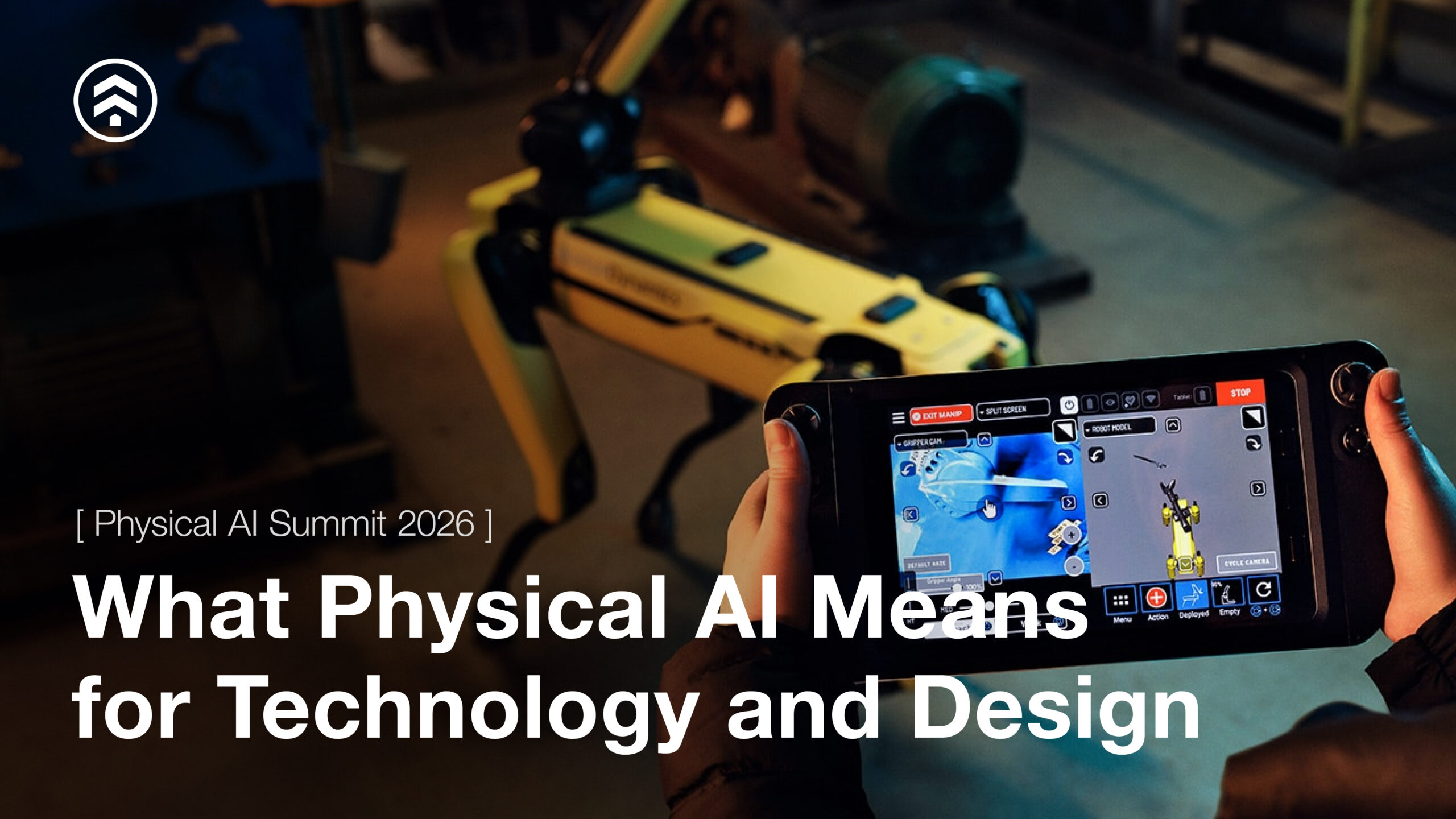
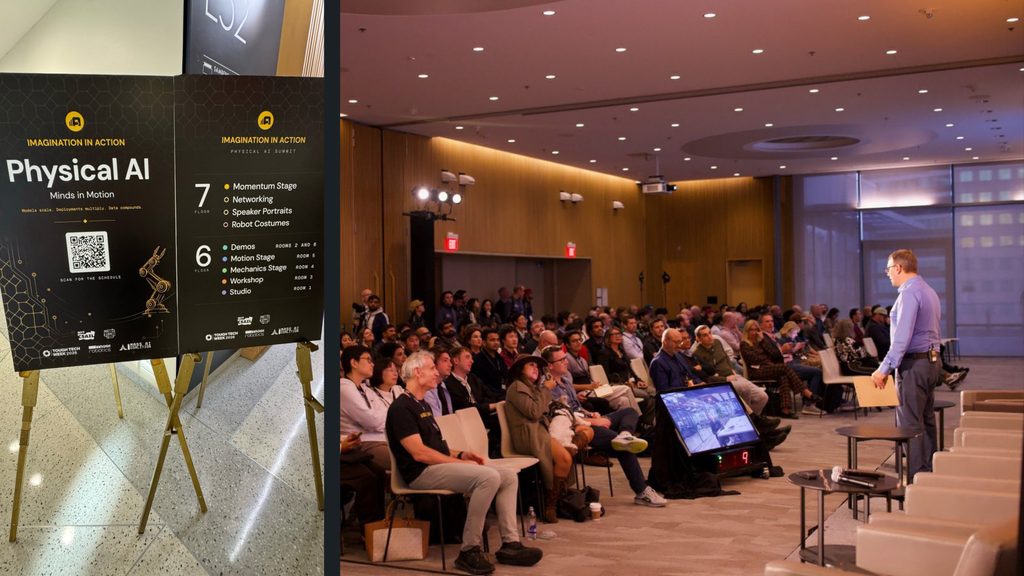
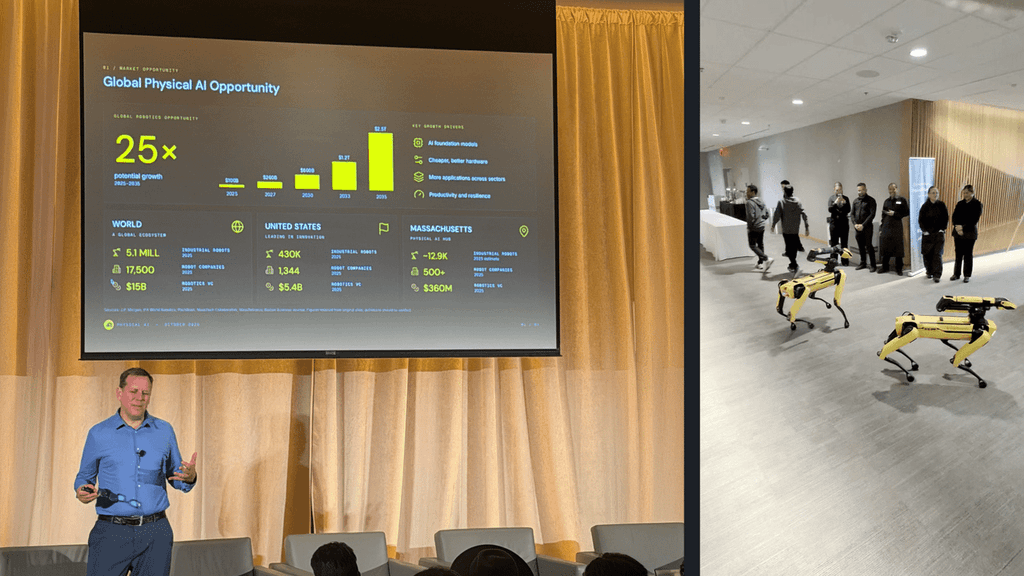
Last week, I attended the first-ever Physical AI Summit at MIT, bringing together leaders in artificial intelligence, robotics, engineering, and design to explore how AI is moving beyond screens and into the physical world.
We’ve spent the last few years talking about AI on our computers and phones. Now, we’re beginning to bring that intelligence into machines, products, and systems that can see, think, learn, move, adapt, and interact with the world around them.
And this isn’t just about robots. It’s about the intersection of AI, robotics, hardware, design, engineering, and human experience.
The summit brought together leaders from MIT, Amazon Robotics, MassRobotics, iRobot, and a wide range of startups, research institutions, manufacturers, and investors.
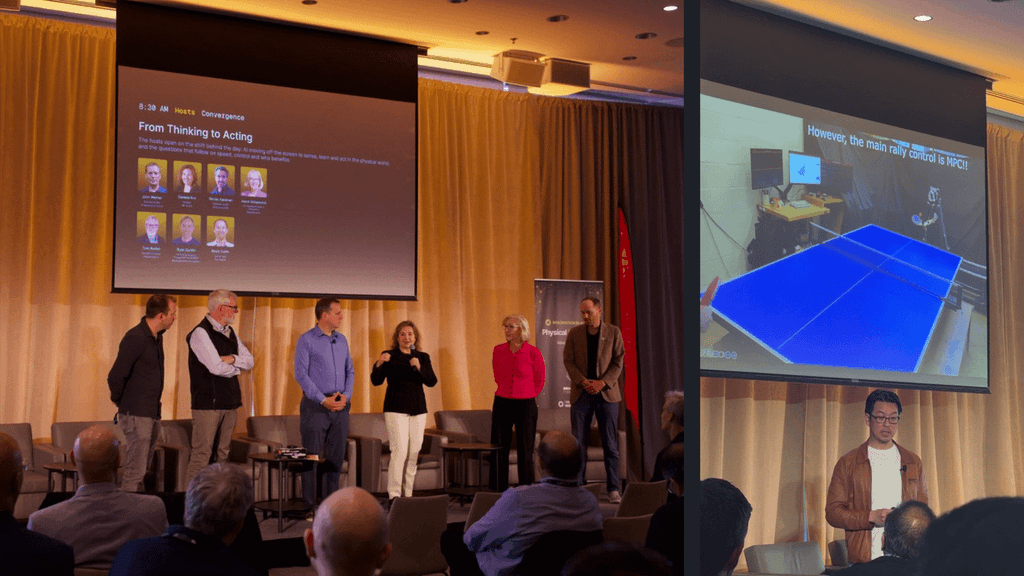
Across the presentations, demonstrations, and conversations, several themes stood out.
Here are six takeaways that have me thinking about what’s ahead.
1. Physical AI is much bigger than robots.
One of the most interesting discussions centered on humanoid robots. It makes sense to build robots that look and move like humans, at least for now. Our world has been designed around the human body. Factories, tools, buildings, vehicles, and workspaces are all built for people.
Creating robots that can operate in these existing environments could accelerate adoption without requiring companies to redesign everything around them.
But how long will that remain the best approach?
Eventually, we may start redesigning equipment and environments around robots themselves. We’re already seeing companies question assumptions as basic as whether a robotic hand needs five fingers, or even fingers at all. Depending on the task, an entirely different form could make more sense.
As a designer, I find this fascinating. We’re reaching a point where we can rethink how products, equipment, and environments should work.
And the possibilities extend far beyond humanoids. Autonomous vehicles, intelligent industrial and agricultural equipment, connected consumer products, and medical technology are all part of this emerging landscape.
The opportunity isn’t simply making existing machines smarter. It’s rethinking what physical products can do when intelligence is built directly into them.
2. The technology is advancing quickly. Scaling it will be the real challenge.
One message I heard repeatedly was that while the US has incredible talent and innovation, our ability to manufacture and scale these technologies remains a major challenge.
Developing advanced robots and AI-enabled machines is only part of the equation. Bringing them to market requires motors, actuators, sensors, semiconductors, batteries, materials, precision components, and manufacturing partners. Many of those supply chains are currently concentrated overseas.
There’s a real opportunity for robotics and AI to strengthen domestic manufacturing, but we need the infrastructure to make that possible.
MIT’s John Hart and Sangbae Kim discussed how advanced materials, new alloys, additive manufacturing, and more adaptable production systems could change how the next generation of machines is made, and what we’re capable of designing in the first place.
Innovation doesn’t stop at the prototype. Turning a promising concept into a reliable, commercially viable product requires design, engineering, materials, manufacturing, and supply chains to work together from the beginning.
The companies that connect those pieces will have a significant advantage.
3. Intelligence is moving from the cloud into products themselves.
Another theme that stood out was the growing importance of edge AI.
Much of the AI we interact with today relies on large cloud-based systems. But physical machines often need to make decisions immediately, without waiting for information to travel to and from a remote server.
Think about an autonomous vehicle navigating traffic, a robot working alongside people, or a medical device monitoring someone’s health. Speed, reliability, privacy, and power consumption become critical.
As computing hardware improves, more intelligence can run directly on the device. I don’t think the cloud is going away, but we’ll likely see more intelligence built into the products we use.
Imagine products that don’t simply respond to commands, but understand their environments, anticipate needs, and adapt to the people around them.
That creates new possibilities for product designers and engineers. We’re no longer just designing a product’s physical form and interface. We’re considering how it senses, processes information, makes decisions, and responds to the world.
4. The real-world applications are already impressive.
Some of the most compelling presentations focused on how physical AI and robotics are being applied today, particularly in healthcare, manufacturing, and logistics.
One of my favorite sessions was Beyond Human, which explored the intersection of biology, robotics, materials, and artificial intelligence.
Hugh Herr from MIT discussed bionics and the potential for technology to do more than restore lost human abilities. Advanced prosthetics could eventually allow people to move and perform in ways that go beyond conventional human capabilities.
Canan Dağdeviren from MIT presented wearable medical technologies, including ultrasound systems that could make certain types of health monitoring more accessible. The idea of embedding sophisticated diagnostic technology into something as familiar as clothing is remarkable.
Jamie Paik from EPFL discussed Robogami, her work with soft, modular, adaptable robotic systems. Bertrand Duplat of Robeauté presented miniature robotic technologies designed to navigate areas of the brain that are difficult to reach with conventional surgical tools.
These are very different applications, but they point toward the same possibility: physical AI could fundamentally change how we diagnose conditions, treat patients, restore mobility, and interact with the human body.
We also heard from Tye Brady, Chief Technologist at Amazon Robotics, who shared a look at the scale of automation across Amazon’s operations. Amazon has deployed more than one million robots across its fulfillment network, with robotic systems supporting a significant portion of customer orders.
These aren’t experimental machines performing a few tasks in a lab. They’re operating across enormous networks, handling products of different shapes, sizes, weights, and packaging while adapting to changing demands.
It’s one thing to watch a robot perform in a controlled demonstration. It’s another to see these technologies deployed at this scale.
For me, that’s where physical AI becomes especially meaningful. It’s not just about making machines smarter or more productive. It’s about what these technologies can make possible for people.
5. Massachusetts has an opportunity to lead this next generation of technology.
Having been born and raised in Boston, I’ve always been a huge advocate for this city and Massachusetts. I’ve built my life and business here, and I believe this is one of the most exciting places in the world for innovation, creativity, education, and entrepreneurship.
After attending this summit, I’m even more convinced that we have an opportunity to lead the next generation of technology.
Between MIT, Harvard, MassRobotics, Amazon Robotics, research institutions, startups, investors, engineering firms, and design companies, we have an extraordinary concentration of talent. Many of the people helping shape the future of physical AI are already right here.
Organizations like MassRobotics and the Massachusetts AI Coalition are helping connect founders, researchers, investors, and established companies. That collaboration is essential to moving promising ideas out of research labs and into real products and businesses.
But great ideas and research aren’t enough. We need investment, manufacturing capabilities, facilities, workforce development, and opportunities to test and deploy these technologies here.
We should be thinking about how to make Massachusetts one of the most attractive places in the world to start, build, test, manufacture, and scale physical AI companies.
We already have many of the ingredients. Now we need to bring them together.
6. Where does design fit into all of this?
This is something I’ve been thinking about quite a bit, especially as we explore how Sprout Studios can contribute to this emerging industry.
One thing I noticed at the summit was that much of the conversation focused on robotics, AI models, and engineering, with relatively less attention on the broader world of AI-enabled physical products and the role design plays in bringing them to life.
I see an enormous opportunity there.
The next generation of intelligent products will need more than sophisticated AI models and engineering. They’ll need to be intuitive, useful, reliable, manufacturable, and thoughtfully designed.
That means physical forms suited to their environments, materials and ergonomics that account for how people interact with them, and interfaces that help people understand and trust what a product is doing. Clear branding, messaging, and storytelling will also matter as people encounter technologies that may be entirely new to them.
Consider a robot working alongside people in a manufacturing environment. Its capabilities are important, but so are how it moves, how people interact with it, how safely it operates, and how easily workers understand its purpose.
Or consider a wearable medical device. The technology might be extraordinary, but if it’s uncomfortable, confusing, or difficult to incorporate into someone’s daily routine, adoption becomes much harder.
These aren’t just engineering challenges. They’re design challenges.
At Sprout, this is the kind of multidisciplinary work we love. We bring together research, strategy, innovation, industrial design, engineering support, branding, visualization, and digital experiences to help companies turn complex ideas into real products.
As AI moves into the physical world, these disciplines will become increasingly important. People still need to understand, interact with, and trust the technology around them. Thoughtful design can make the difference between a technically impressive product and one that people actually want and know how to use.
I believe there’s tremendous opportunity for companies like ours to help shape what comes next.
Looking ahead…
It’s incredibly exciting to think about the opportunities ahead for the next generation entering the workforce.
No generation has had access to this much technological capability. AI is already changing how we research, learn, design, write, code, analyze, and solve problems. The tools are available, and the pace of development is only accelerating.
My advice to young people is simple: start experimenting. You don’t need to know exactly what you want to do with your career or become an AI engineer. But understanding what these tools can do, where their limitations are, and how to apply them to real problems will be increasingly valuable.
Be curious. Ask questions. Try things that might not work. Don’t be afraid to break things. That’s how you learn.
At the same time, we need to think carefully about what we’re building and why. The goal shouldn’t simply be to create technology because we can. We should be asking what problems are worth solving and how these technologies can improve the world around us.
I left MIT feeling fired up about what’s ahead. We’re witnessing the beginning of something that could fundamentally change how we live, work, manufacture, and interact with the world.
And I couldn’t be more excited to be part of it.
A huge thank-you to John Werner, founder of Imagination in Action, for helping bring this event together, along with MIT CSAIL, MIT LIDS, MassRobotics, TEDxMIT, The Engine, the Massachusetts AI Coalition, and everyone else involved.
Here’s to more collaboration, more innovation, and more opportunities to build the next generation of technology right here in Boston.
Let’s keep the momentum going!