Intro
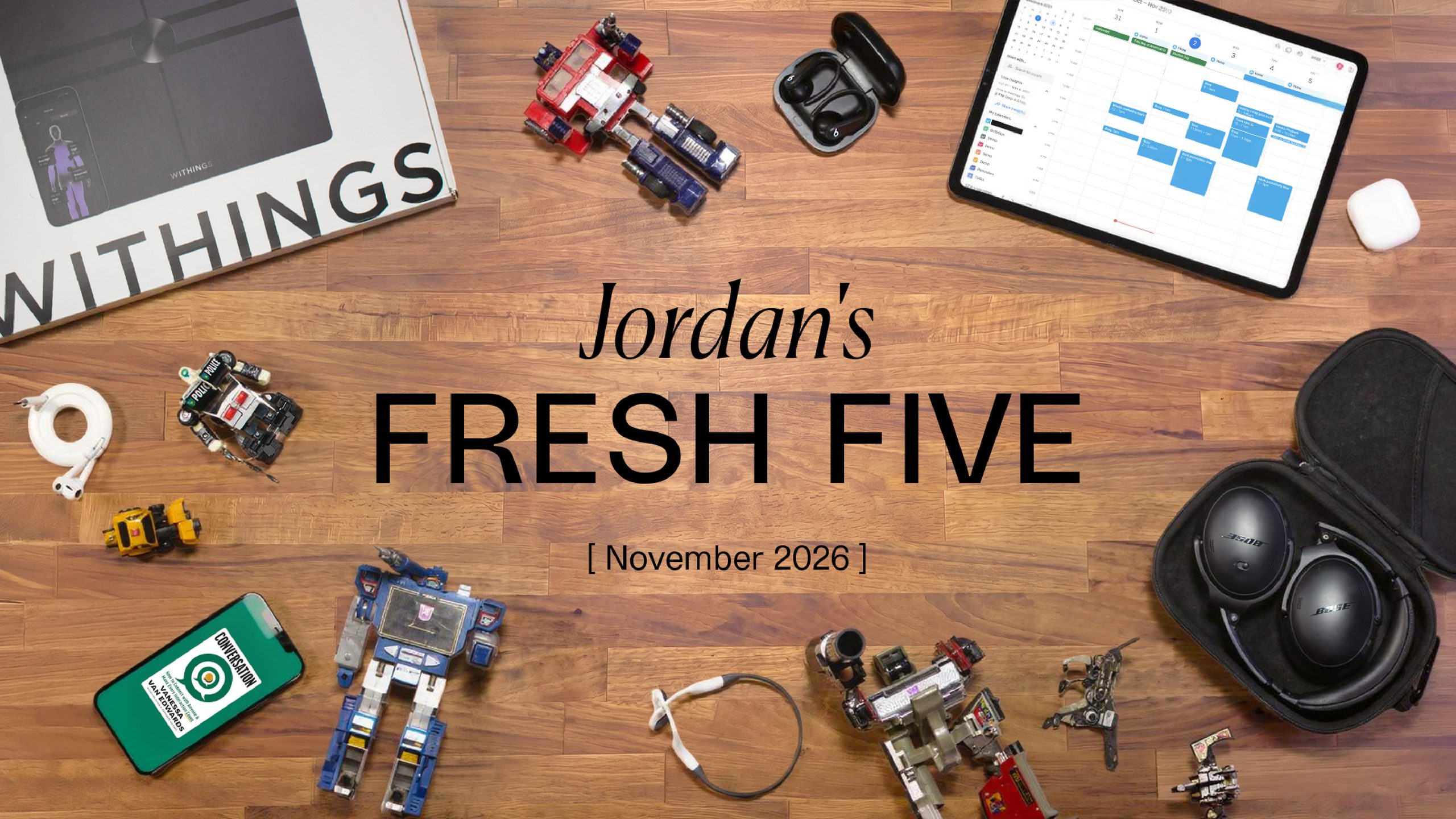
1. From My Collection: Transformers, Where It All Began
I’ve always been a collector. It started back in high school with my love for toys and has grown into a pretty extensive collection of objects that catch my eye and inspire my creativity. From vintage toys and retro electronics to modern collectibles, books, movies, gadgets, and unique products, I’ve always been fascinated by the creativity, design, and stories behind the things we surround ourselves with.
In fact, toys were one of the reasons I got into industrial design in the first place. Early on, I thought I was going to become a toy designer. While my career ultimately took me in a much broader direction, that same curiosity has never left me. Whether it’s a beautifully engineered toy, an iconic piece of consumer electronics, or an innovative new product, I’m constantly drawn to objects that challenge conventions, spark ideas, or simply make me appreciate great design.
So I’m introducing a new section to Fresh Five called From My Collection, where I’ll share some of the objects from my personal collections. Some will be nostalgic, others will highlight great design and innovation, and a few might just be things I think are really cool.
This month, I want to share where it all began: Transformers.
If there’s one toy line that really started it all for me, it’s the original Transformers.
I still remember walking the toy aisles at Service Merchandise and Spag’s, a legendary discount retailer in Shrewsbury, Massachusetts, hoping to find a new Transformer. The excitement of picking out one or two for my birthday or the holidays was hard to beat. And, of course, there was the daily ritual of racing home after school to watch the Transformers cartoon. For a kid who loved toys, design, and anything mechanical, these were pretty much the coolest things imaginable.
What fascinated me then, and perhaps even more today as an industrial designer, was the incredible creativity and engineering behind these transforming robots. Many of the original toys were actually developed by Japanese toy company Takara before Hasbro licensed and introduced them to American audiences in 1984. What’s even more remarkable is that these intricate designs were created long before today’s sophisticated 3D CAD tools. The mechanisms, moving parts, and transformations were developed through traditional design, engineering, and physical model-making. When you consider the complexity of turning a realistic vehicle into a robot, and back again, the ingenuity is pretty mind-blowing.
But Transformers weren’t just great toys. They had personalities, stories, and an entire universe built around them. Each character had its own identity, from its appearance and transformation to its voice and personality. The animated series brought them to life, and the 1986 theatrical movie took things to another level. I still remember how incredible the animation, storytelling, and voice performances were. It was a brilliant combination of product design, character development, and storytelling that made these toys so much more than objects on a shelf.
Interestingly, my collection focuses almost exclusively on the original Hasbro releases from 1984 and 1985, with a select few from 1986. As a designer, I found myself losing interest in many of the later generations. The originals had a certain weight, quality, and authenticity that I loved. Many incorporated die-cast metal, detailed mechanical components, and realistic vehicle designs. As the line evolved toward more plastic construction, some of that tactile quality and mechanical sophistication seemed to disappear for me. There’s something incredibly satisfying about holding one of those early figures and appreciating how it was designed and manufactured.
I’ve been slowly working toward completing this collection since I was a kid, and I’m happy to say I’m now only about six figures away! Of course, there are still plenty of accessories, weapons, and missing pieces to track down, which is part of the fun. The hunt has become almost as enjoyable as the collection itself.
Transformers remain one of my most prized collections, and I still enjoy pulling them out, transforming them, and appreciating the creativity that went into each one. Looking back, I can see how much these toys influenced my interest in industrial design. They weren’t just something I played with. They helped me understand how imagination, engineering, and storytelling could come together to create something truly memorable.
And decades later, they still inspire me.
2. Reading: Conversation: How To Connect With Anyone & Make Every Interaction Count By Vanessa Van Edward
As AI becomes a bigger part of how we work and live, I think one of the most important skills we can develop is also one of the most human: the ability to have a meaningful conversation.
There’s so much conversation right now about what AI will change, replace, and automate. In the middle of all that, I think we’re overlooking just how valuable genuine human connection really is.
As we spend more time interacting with technology and increasingly AI, it’s easy to become siloed in our own routines and digital worlds. Whether it’s catching up with friends, building relationships, collaborating at work, or selling an idea, the ability to have a meaningful conversation is becoming more important than ever.
You can automate a lot of things, but you can’t automate the feeling of having a great conversation with someone. The more AI becomes part of our everyday lives, the more valuable these distinctly human skills will become.
That’s what drew me to Conversation: How to Connect with Anyone & Make Every Interaction Count by Vanessa Van Edwards, a behavioral researcher and founder of Science of People.
The book takes something we often consider a natural ability and breaks it down into practical skills we can all improve. From asking better questions and becoming a better listener to understanding body language and building stronger connections, it’s a reminder that great conversations don’t always happen by accident.
As someone who spends much of my time collaborating with designers, clients, and entrepreneurs, it’s a skill I think is worth investing in. AI may make us more efficient, but our ability to connect with people is what makes those interactions meaningful.
3. Product: The Perfect Pair
I’ve been testing different headphones trying to find the perfect pair, and I hate to admit it, but I somehow ended up with five. Each has its purpose depending on where I’m going, what I’m doing, and how much I want to hear what’s happening around me.
Bose QuietComfort Headphones: My go-to for travel and anytime I want to completely zone out. They’re lightweight, comfortable, and especially good for long stretches. They’re also great in the winter since they keep your ears warm. The downside is that Bluetooth can be a little inconsistent, and I’ve had mixed results with phone calls.
Powerbeats Pro 2 Wireless Earbuds: These are my go-to active-use headphones. The ear hooks mean they actually stay put, and they have the convenience and ecosystem of Apple products. They also seem to have better noise cancellation than my older AirPods.
Shokz OpenSwim Pro: I used these a ton this summer because they’re actually waterproof! Bone conduction keeps your ears open, and you can really swim with them on while listening to music.My primary use was for longer stand-up paddleboard sessions, and they were great for that.The biggest downside is volume. They can be difficult to hear on a windy bike ride, for example. They also use a proprietary charging connector, which is easy to forget about until you’re sitting there with a dead pair and no charger.Still, being able to listen to podcast & music while I paddleboard makes these a necessary part of my collection.
Apple AirPods: Still the easiest option for everyday carry. They’re tiny, take up almost no room in my bag, and are reliable for calls and dictation. The tradeoff is that they don’t always stay in my ears, which makes them less ideal for anything active.
Apple Wired EarPods: Old reliable. No Bluetooth, no charging, no pairing, no problem. There’s something strangely satisfying about plugging in a pair of headphones and getting on with it. I keep pairs in my bag, vehicle, and desk just in case. The obvious tradeoff is that you’re tethered to your device, which can be limiting when you’re moving around or want more freedom. But for everyday listening, calls, or when your wireless headphones inevitably run out of battery, they’re hard to beat.
They’ve also become surprisingly popular with my kids, which got me thinking about the bigger comeback wired headphones are having, especially with younger generations. There’s something interesting happening here. After years of pushing wireless technology forward, people are rediscovering the appeal of a simple cord. Part of it is nostalgia, but a lot of it comes down to convenience. You don’t have to charge another device, worry about Bluetooth connections, or wonder where you left an earbud.
Apple’s inexpensive wired EarPods are part of that story, but even premium audio brands are taking notice. Bose recently introduced a $99 pair of wired earbuds with noise cancellation, and demand has been strong enough that its initial preorders sold out quickly. It’s an interesting reminder that newer isn’t always better, and that sometimes the best product experience comes from making something simpler.
The conclusion after months of testing a dozen different headphones in my quest for the perfect pair? Maybe the better approach is accepting that different situations call for different tools.
4. Health & Wellness: Beyond The Scale
My ongoing interest in longevity and biohacking has led me to explore another way of tracking my health: smart body composition scales. After using WHOOP for sleep and recovery and Function Health for blood biomarkers, I wanted to better understand what’s happening with my body beyond just weight. These advanced scales can estimate body fat percentage, muscle mass, visceral fat, hydration, bone mass, and metabolic indicators. For me, the real value is understanding how my body is changing over time, particularly when it comes to maintaining muscle, reducing body fat, and staying healthy and active as I get older.
I recently tested both the Hume Health Body Pod and the Withings Body Fit, ultimately choosing Withings. As an industrial designer, I was immediately impressed by the overall product experience. From the moment you open the box, the packaging, product design, and attention to detail communicate a premium experience. The scale itself is beautifully designed, and in my opinion, a step above much of what’s on the market. It’s clear that Withings has put thought into the entire customer experience, not just the technology. Combined with its long-standing reputation as a leader in connected health, broader product ecosystem, and no required subscription for core features, it was an easy choice.
My experience with Hume was quite different. While it advertises free access to basic measurements, getting the full benefits requires upgrading to its paid Plus plan. Its customer service was also pretty atrocious, which didn’t exactly inspire confidence. Beyond that, I’m skeptical of some of the bold accuracy claims made in this category. These devices use bioelectrical impedance to estimate body composition, and factors like hydration, exercise, and even the time of day can influence results. I view them as tools for tracking trends rather than treating every measurement as an absolute.
To establish a more reliable baseline, I also had a DEXA scan, one of the established reference methods for measuring body composition. It provides a more detailed picture of fat distribution, lean tissue, and bone measurements. While having one at home isn’t practical, DEXA scans are available through some medical facilities, fitness centers, and specialized clinics. My plan is to use DEXA periodically as a reference and the Withings scale to monitor changes in between. It’s another relatively simple addition to my longevity toolkit, giving me more information to make informed decisions about my health. Ultimately, I’m not looking to obsess over every number. I’m looking for ways to better understand my body, measure progress, and hopefully stay healthier for longer.
5. AI: Practical Applications, Real Results
Every fall, one of my most dreaded tasks is getting everyone’s schedules synced up. I’ve got two kids with multiple sports and activities, plus my own work calendar, meetings, appointments, and everything else. It usually takes hours to input all the dates and keep everything organized.
This year, I dropped the various URLs, PDFs, and documents into ChatGPT and asked it to turn everything into something I could import directly into Google Calendar. It created a CSV file, I imported it, and done. What would normally take hours was reduced to a few minutes. It’s a relatively simple application of AI, but that’s exactly the point. Sometimes the biggest wins come from eliminating the little tasks that eat up our time.
I’ve been experimenting with AI for years, but I haven’t really shared much about how I’m using it in my everyday life, from the little time-savers to some pretty mind-blowing applications. Lately, I’ve been taking things a bit further, building custom tools and dashboards and experimenting with AI agents that can handle increasingly complex tasks. The improvements in efficiency have been incredible, both personally and professionally. Over the next few months, I’m planning to share more of these experiences, starting with simple applications like this and gradually introducing some of the more advanced things I’ve been working on.
There’s certainly no shortage of people talking about AI, but I want this part of Fresh Five to focus on practical applications and real results. Things you can actually put to use without needing to be a programmer or an AI expert. My goal is to share what I’m learning, what’s working, and how you can start applying some of these tools quickly and easily to make your own life a little more efficient.
And yes, there are definitely some tasks I’ll gladly let AI replace.