Product visuals do far more than capture attention—they drive decisions. As e-commerce, retail media, and global product launches accelerate, brands are under increasing pressure to produce high-quality, flexible visuals at scale.
Traditionally, product photography has been the gold standard. But in recent years, photorealistic 3D product rendering (CGI) has evolved from a niche capability into a core visual strategy. Advances in rendering technology, automation, and AI-assisted workflows have changed not only what’s possible but how brands evaluate speed, cost, and long-term value.
In this article, we compare CGI and traditional photography, outlining the benefits, trade-offs, and decision criteria brands should consider.
Benefits of 3D Product Rendering for E-commerce Retailers
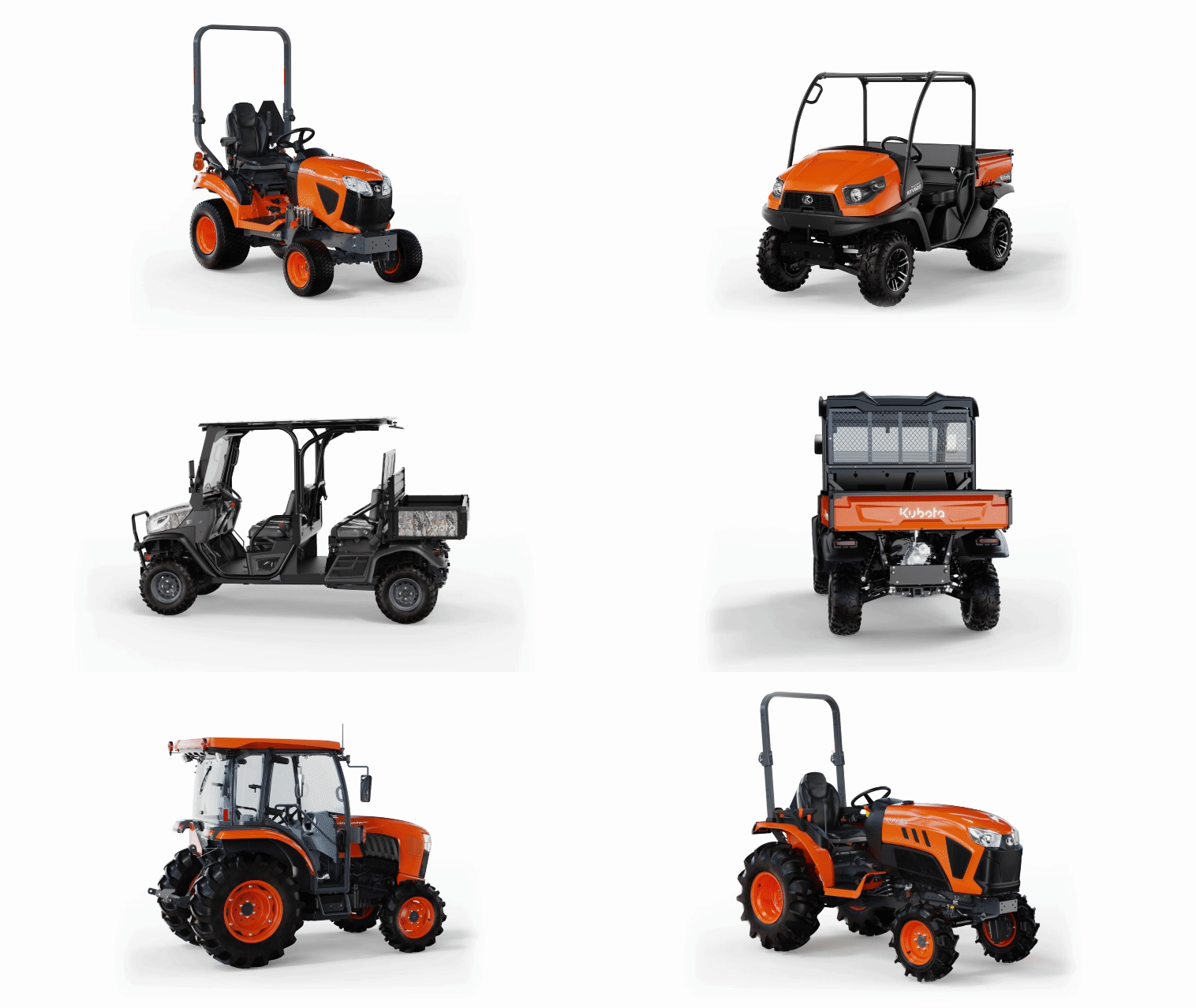
Increase Profit: Companies adopting CGI have experienced up to a 40% higher online conversion rate and up to a 30% lift in average sales prices when using 3D models to replace static 2D images. Brands also report up to an 80% reduction in returns after using 3D visualization. These statistics indicate that investing in high-quality visuals can lead to significant business growth. From hero images that can stop shoppers mid-scroll, to detailed views that communicate differentiated features and quality, CGI helps to close that sale.
Save Time & Money: Product marketing relies on accurate imagery to drive storytelling. But traditional photography is expensive (and exhausting) — from transporting products and coordinating staff to renting a studio, equipment, and photographer. It is also risky — when the final product is delayed or the first articles have blemishes that require retouching, timelines and budgets suffer. CGI reduces those risks. Modifying digital images is a much more cost-effective process than re-shooting an entire campaign and creating complex environments and in-context imagery can be achieved at a fraction of the cost and time.
Augment the Product Development Process: Our clients use CGI to evaluate the ROI of product features before tooling or to measure market interest by segment or by SKU so that forecasts for overall volume match demand. With product renderings, retailers can A/B test and evaluate different imagery to gauge customer response, determine what drives conversions, and adapt to those results in real-time. Insights can help fine-tune an offer prior to production and creative teams are free to explore alternate product configurations, designs, styles, color schemes, textures, and backgrounds.
Build Once, Use Often: Digital assets can be used indefinitely across multiple mediums from your website and social media, to marketing collateral or on packaging. Once set up, the ability to change angles, lighting, and environments to keep content fresh is unsurpassed. Additionally, you can create scenarios that would be impossible (or at least, extremely difficult and expensive) with traditional photography. Your digital library will include props and environments to compose ownable scenes unique to your brand, over and over again.

Challenges of Replacing Product Photography with CGI
While the benefits of CGI are numerous, there are some challenges that e-commerce retailers may face when making the switch. However, the three main issues we run into with clients can be overcome with proper early-stage planning.
CAD Consistency: The quality of available CAD is of utmost importance in creating high-quality 3D product renderings. However, some product and manufacturing teams do not have consistent file quality standards which can multiply the time required to execute the project. We use a variety of tools to analyze and repair CAD, and to identify where we can automate or gain efficiency in the process. If CAD is unavailable, our CGI experts can create 3D models from sketches, photos, or physical references.
Setting Standards: Sprout starts enterprise visualization projects with the development of style guide(s), ensuring consistent quality no matter how high the volume. Alignment between internal product, merchandising, and marketing teams is crucial to establishing creative standards that work across the board. This can require some recalibration for teams who typically have independence in decision-making.
Decisions, Decisions: CGI allows for a much more accelerated process compared to photography. This means making decisions earlier in the product cycle, which can be a new and unfamiliar territory for some. Delays in decision-making can result in rework, costing unexpected time and money.
How AI and Automation Are Changing the CGI vs. Photography Decision
Recent advances in AI and automation have fundamentally changed how CGI is created and deployed. What once required significant manual effort can now be streamlined through automated workflows, reducing production time, minimizing human error, and enabling consistency across thousands of assets.
At Sprout Studios, we integrate AI-assisted tools and custom scripting into our CGI pipelines to accelerate repetitive tasks such as material application, camera setup, and file formatting. This allows teams to focus on creative decision-making rather than production bottlenecks.
The result is a visual system that supports rapid iteration, global SKU expansion, and omnichannel reuse—something traditional photography struggles to deliver without escalating costs. As content demands grow across e-commerce, retail media, configurators, and emerging platforms, CGI increasingly becomes the backbone of scalable product visualization strategies.
CGI vs. Photography Costs: Short-Term Investment vs. Long-Term Value
When evaluating CGI for product visualization, it’s important to balance the upfront investment against long-term benefits. While traditional photography often represents a one-time cost, CGI assets can be reused across multiple campaigns, channels, and SKUs—providing ongoing value over time. With our clients, we have seen reuse range from 5% to over 50% depending on how CGI was integrated into their product and marketing teams.
For many businesses, the ability to iterate quickly, scale across SKUs, and maintain consistency across channels often makes CGI a compelling long-term investment.
Cost Drivers:
- The quality of existing files and/or CAD and if CAD needs to be repaired or created will largely dictate initial project costs.
- The complexity of the product and its materials contribute to the overall amount of time required to visualize each product, impacting the cost per product.
- The number of products to be rendered, the number of views for each, and whether interactive views or animations are requested will also directly impact the cost per product.
- The ability to automate the process can lower costs. At Sprout Studios, we specialize in customizing CGI workflows and streamlining digital processes to fit the needs of each project. To achieve high volume output (and remove human error), we develop code that scripts parts of a visualization workflow where possible. We use this programming in a variety of ways from importing a model, applying materials, queuing camera views, and even formatting and transferring files.
Instances Favoring Traditional Imaging
CGI shouldn’t be seen as a rival to traditional photography, but rather as complementary tools that serve different purposes in different situations. While CGI offers numerous benefits, it’s important to recognize that traditional photography still has its place in certain situations.
Capturing organic matter such as food, plants, and animals can be challenging to replicate with CGI, making photography a preferred option to showcase the natural beauty and detail. The unique interaction between organic matter and light is difficult to simulate perfectly.
The ability to produce authentic human expression, body language, and individual characteristics, such as freckles and laugh lines, presents unique challenges for CGI. These nuanced elements of human experience are often best represented through the lens of traditional photography.
Similarly, photography excels at portraying human interaction with a product, as it allows the simulation of natural physics involved when items are touched, held, or used. The complex and time-consuming task of accurately simulating these physical interactions to appear authentic in CGI can be streamlined through the use of photography.
In some instances, our team may recommend that photography be used in conjunction with CGI. Our in-house teams and network of imaging partners work seamlessly in collaboration with one another, leveraging the strengths of each tool to achieve the most compelling visual results. By recognizing the distinctive advantages of both CGI and traditional photography, we ensure the optimal presentation of any subject matter, catering to the unique demands of each individual project.
CGI is ideal when:
- Products have many SKUs, finishes, or configurations
- Speed-to-market and iteration matter
- Assets need to be reused across channels and regions
Photography is typically ideal when:
- Human emotion or organic materials are central
- Authentic interaction is required

Connect With Our CGI Experts
Photorealistic 3D product rendering can boost conversions, increase average order value, and provide flexible, reusable assets across channels and campaigns. Choosing the right approach—CGI, traditional photography, or a hybrid—depends on your products, timelines, and business goals.
To discuss your next project or learn how 3D product rendering can work for your organization, contact our CGI experts today.
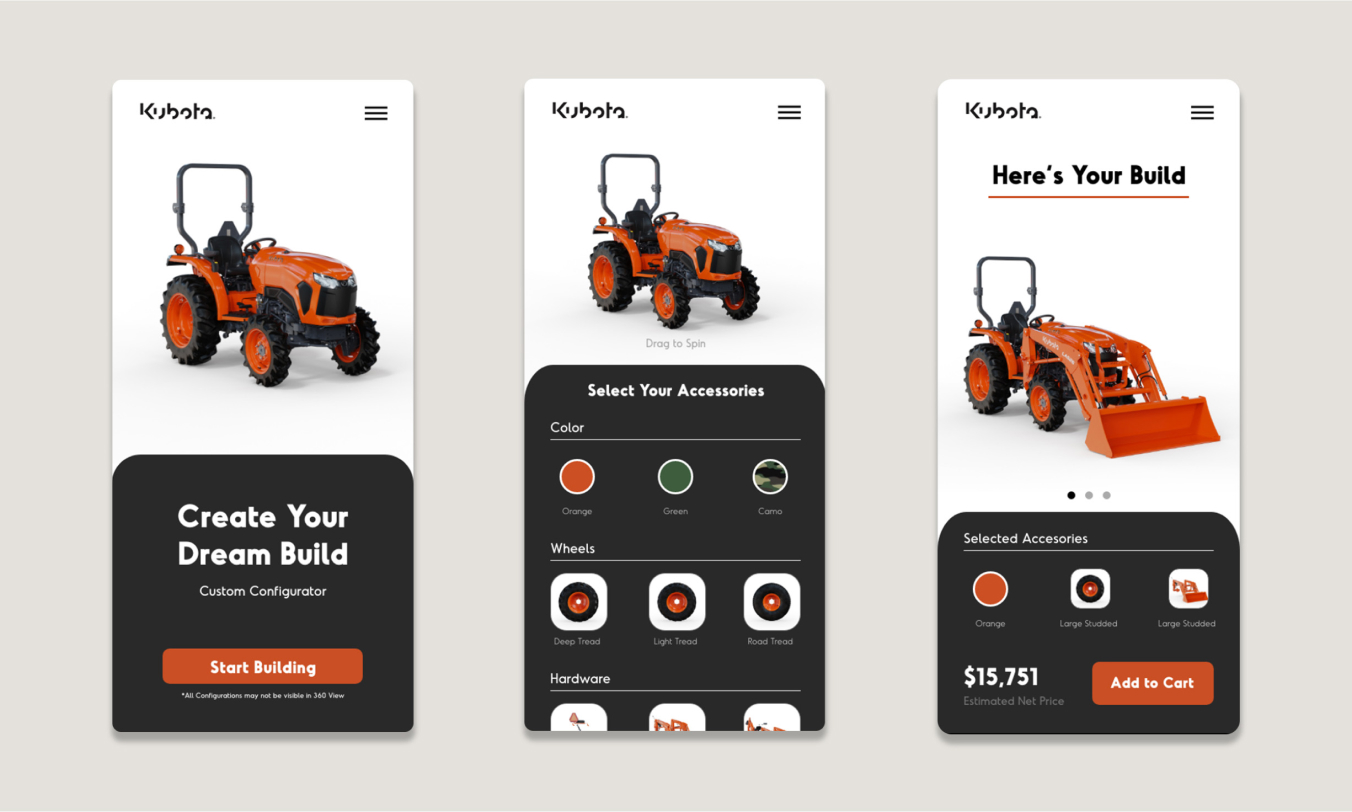
-> See how we brought Kubota Tractor Corporation’s full product portfolio to life with over 50,000 photorealistic CGI assets, powering thousands of configurations and creating a seamless digital buying experience in our Kubota Case Study.