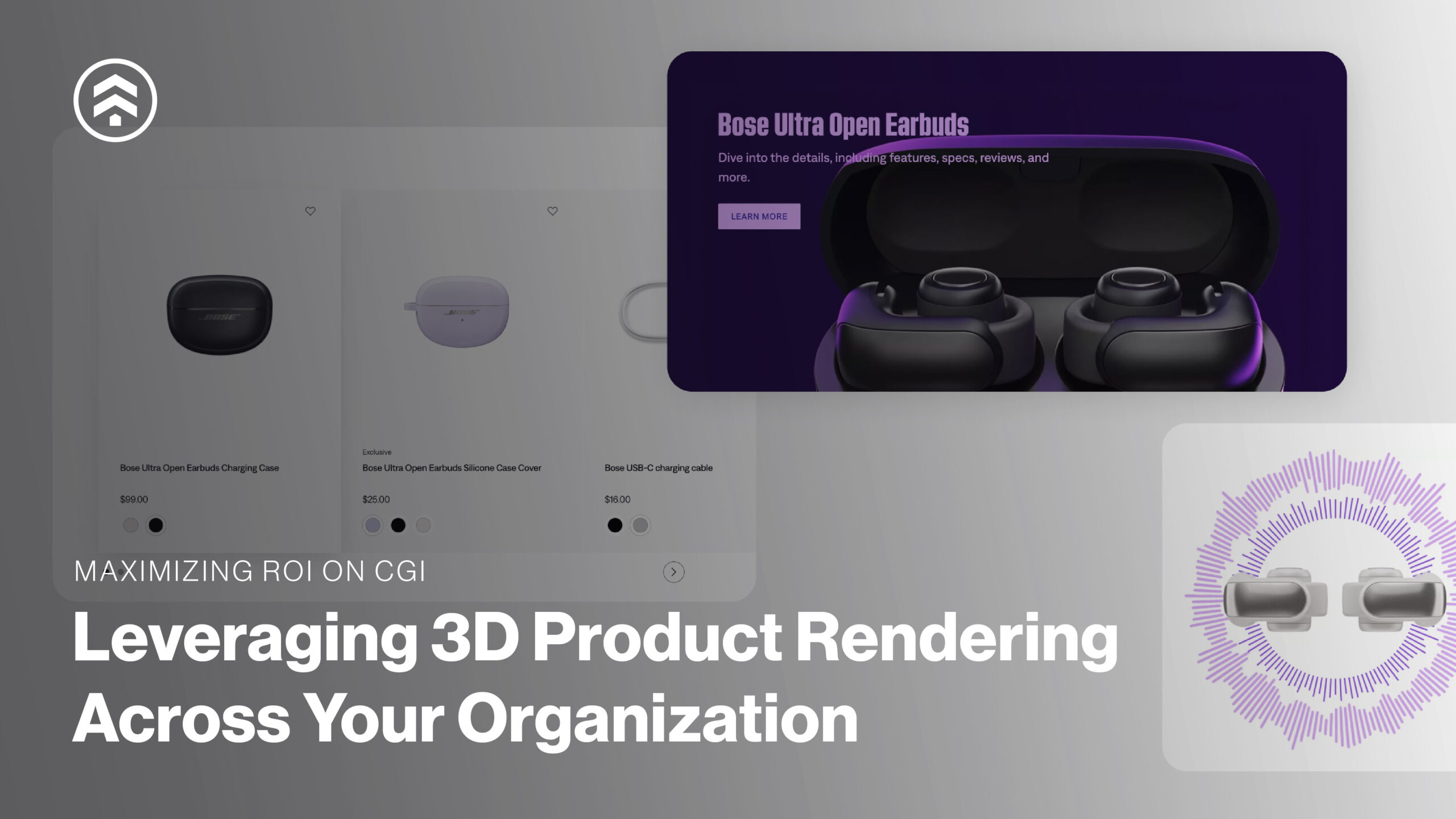
High-fidelity 3D product renderings enable teams to visualize, refine, and showcase products from concept to market—all without waiting for physical samples. By creating photorealistic digital models, companies can streamline product development, reduce errors, and enhance marketing and sales, providing customers with a comprehensive, interactive view of their products before they’re even manufactured.
From accelerating development timelines to enhancing customer engagement, 3D product rendering offers organizations improved efficiency, reduced costs, and maximizes return on investment (ROI) at every stage of the product journey. Whether you’re looking to drive engagement in marketing or optimize manufacturing workflows, the strategic use of 3D product rendering can provide a competitive edge and establish a lasting impact across your organization.

Accelerating Product Development with 3D CGI Renderings
As a 3D product rendering studio, Sprout understands that showing is better than telling. In the product development phase, time is of the essence, and delivering a thorough proof of concept quickly is critical.
While traditional 2D mock-ups provide a blueprint, they often fail to convey a full experience. Physical prototypes offer tactile insight but can be costly and time-consuming. 3D product renderings allow teams to see not only how products look but also how they function, serving as both a proof of concept and a call to action for stakeholders.
By visualizing every detail digitally, engineering and design teams can identify potential flaws, iterate rapidly, and refine designs in real-time. This reduces errors, aligns products more closely with market trends and consumer expectations, and accelerates development cycles—ultimately maximizing ROI.
Beyond design, 3D renderings also support precision and efficiency in manufacturing. Realistic models allow production teams to map out assembly processes, anticipate potential issues, and optimize workflows before physical production begins. Complex components can be evaluated for material or structural adjustments, minimizing bottlenecks, delays, and unnecessary costs.
These detailed models also enhance collaboration between design, engineering, and manufacturing teams. Renderings can be shared with suppliers or assembly partners, ensuring everyone operates with a consistent understanding of the product. The result is a streamlined production process that reduces waste, shortens time-to-market, and improves overall operational efficiency.
This approach is especially valuable in industries where precision and efficiency are critical, such as automotive, aerospace, and medical devices. By combining speed, accuracy, and cross-team alignment, 3D product renderings help organizations move from concept to production with confidence and control.
Enhancing Marketing ROI with Photorealistic 3D Renderings
3D product renderings are transforming the way products are promoted, offering high-quality, versatile visuals that can be used across multiple marketing channels—often at a fraction of the cost of traditional photography. Unlike photo shoots, which require physical prototypes, costly studio setups, and professional photographers, 3D renderings create dynamic, photorealistic digital assets that bring products to life in virtually any configuration, color, or style.
These visuals can be repurposed across social media, websites, ads, and product packaging, ensuring consistent branding while saving time and resources. Marketing teams can highlight features, explore multiple settings, and produce campaign-ready assets faster than ever.
This digital flexibility also supports rigorous brand standards, ensuring every visual aligns with the brand’s established look and feel. Once a core rendering is created, it can be adapted for multiple campaigns, updated for new product variations, or tailored for different market segments—all at a fraction of the cost and time compared to traditional methods.
For example, one of our clients, a global manufacturer of construction and agricultural equipment, applied base renderings of a product across multiple scenes. By adjusting the context of each rendering, the product appeared as if it were operating in each target region, helping the brand connect with customers as though the equipment were in their own neighborhoods. This strategy saved on logistics and localized photography costs while delivering versatile, brand-aligned visuals that boosted engagement and strengthened connections with customers across various markets.
Boosting Sales and Engagement with Interactive 3D Product Models
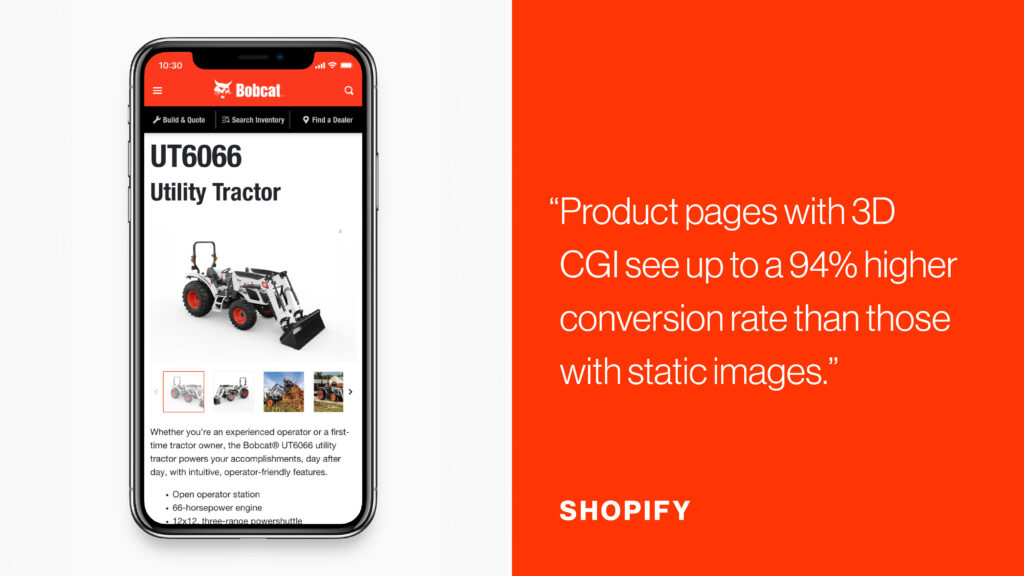
3D product renderings also transform the way customers interact with products online, creating an immersive experience that goes far beyond static images. When shoppers can explore a product virtually—rotating it, zooming in on features, or toggling between options like colors, materials, or configurations—they gain a more complete understanding of the product before making a purchase. This interactive engagement builds confidence, helping customers feel informed and assured in their buying decisions.
Unlike static images, interactive 3D models allow customers to see exactly how a product will look and function in different contexts. Shoppers can fully inspect features, understand scale, and see how variations affect the product, leading to more confident purchases and reduced return rates.
This enhanced engagement doesn’t just improve the customer experience; it also drives measurable business results. Customers who interact with 3D models are more likely to convert, and they spend more time exploring the product’s features, which increases the likelihood of upsells or add-on purchases. The detailed visualization also helps brands differentiate their products in competitive marketplaces, making listings stand out on e-commerce platforms, social media, and marketing channels.
For example, one of our clients leveraged interactive 3D renderings to showcase customizable product options. Customers could switch colors, finishes, and accessories in real-time, creating a personalized experience that increased average order value (AOV) and boosted engagement across their digital channels. By providing a clear, realistic preview of their products, the brand reduced post-purchase uncertainty and generated higher satisfaction and loyalty.
The immersive nature of interactive 3D models strengthens the full sales funnel—from awareness to consideration to purchase—ensuring that customers feel confident and informed every step of the way. By integrating interactive product visualizations into your digital shelf, you can drive conversions, reduce returns, and build stronger, long-term relationships with customers.
Optimizing Training and Support Using 3D Product Visualizations
These digital assets support a wide range of functions, from simple how-to instructions to complex product demonstrations, creating realistic simulations that enhance the user experience.
In industries like medical devices and manufacturing, where products can be highly complex, 3D renderings serve as powerful training tools. For example, Sprout has partnered with medical equipment manufacturers to develop detailed visualizations that enhance training and support. These realistic simulations allow users to explore intricate product features and understand operational workflows in a virtual, risk-free environment. By providing hands-on interaction digitally, teams can better grasp assembly processes, functionality, and maintenance requirements without exposure to the risks or costs of physical handling.
Consistency is another key advantage. High-quality 3D assets ensure that all team members, across locations, receive the same information, reducing discrepancies in training and boosting overall knowledge retention.
In customer support scenarios, 3D renderings can be incorporated into troubleshooting guides, enabling users to identify components and resolve issues visually. This approach improves comprehension, reduces support inquiries, and accelerates problem resolution. By offering interactive and engaging ways to explore products, companies enhance customer understanding, satisfaction, and trust, ultimately fostering loyalty and long-term retention.
Maximizing ROI with 3D Product Rendering
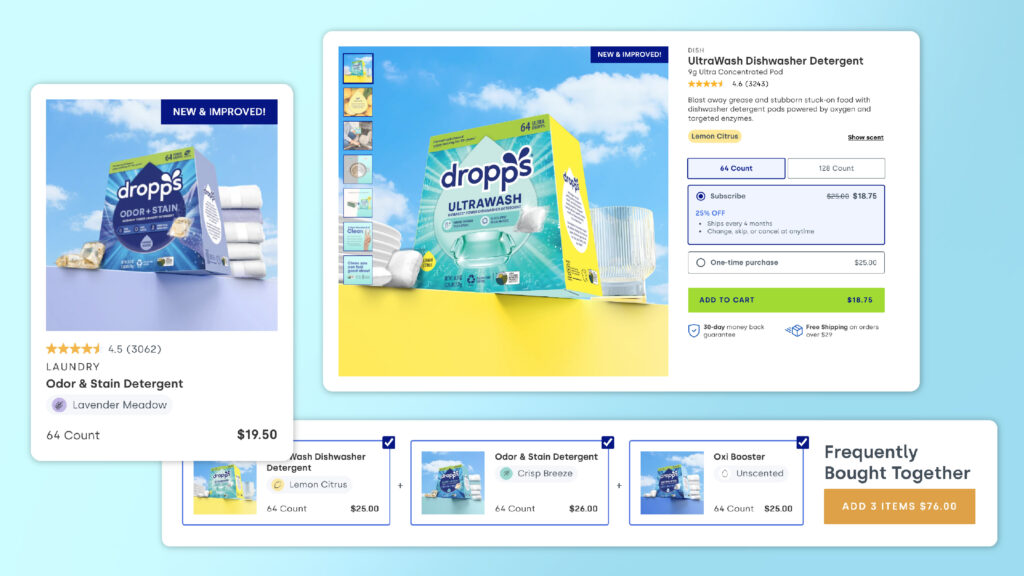
Incorporating 3D product rendering across your organization delivers measurable benefits, from faster product development and optimized manufacturing to more effective marketing and enriched customer interactions.
Investing in high-quality 3D renderings not only supports internal processes but also strengthens brand perception, increases conversion rates, and reduces returns.
Strategically applied CGI becomes a catalyst for innovation, allowing companies to respond quickly to market demands while maintaining a competitive edge. At Sprout, our Boston-based CGI studio specializes in photorealistic 3D product renderings that empower teams, enhance customer engagement, and drive measurable results.
Contact us to learn more about how 3D product rendering can deliver ROI for your next project.