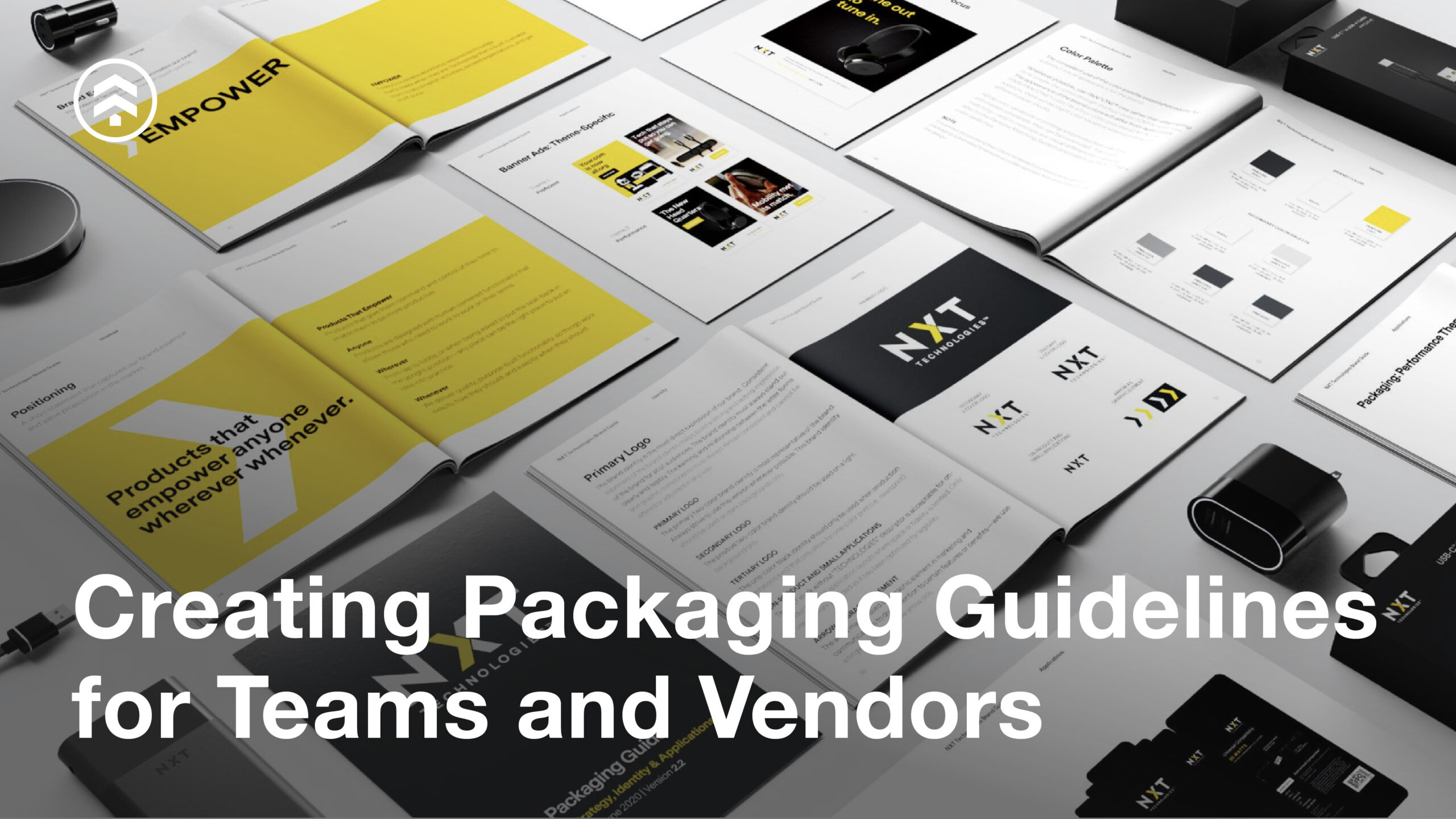
As organizations grow, packaging complexity grows with them. New SKUs, new categories, new vendors, new markets, and larger teams create more opportunities for inconsistency. What begins as a single packaging design often evolves into an entire portfolio that must remain consistent across products, production partners, sales channels, and markets.
Without clear packaging guidelines, small inconsistencies compound. Design systems drift, vendors interpret standards differently, production quality varies, and teams repeatedly solve problems that should already have established answers.
In this article, Ryan O’Donnell, Sprout Studios’ Director of Branding and Creative, draws on his experience building brand and packaging systems to explain what makes packaging guidelines effective in practice. Rather than treating guidelines as a static design document, Ryan looks at how they can help teams, vendors, and partners make consistent decisions, reduce rework, and extend a packaging system as a brand grows.
Packaging guidelines are not simply a design reference. They are an operating system for how packaging is designed, produced, extended, and governed across an organization.
What Are Packaging Guidelines?
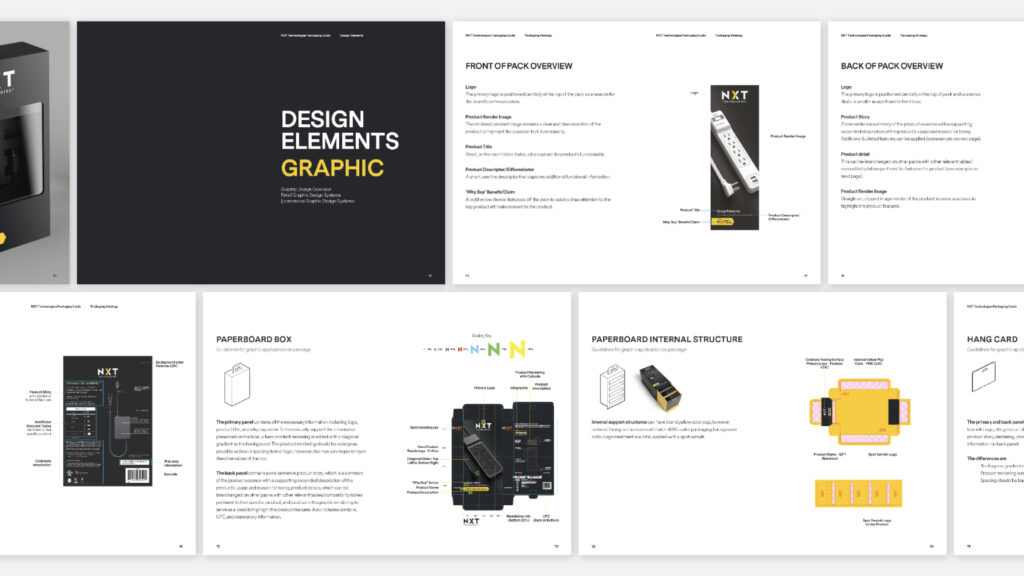
Packaging guidelines define the rules, principles, and production standards that allow a packaging system to remain consistent as products, teams, vendors, and markets change.
They document everything from brand strategy and structural packaging to graphic systems, product architecture, production specifications, and manufacturing requirements, so every stakeholder is working from the same set of standards.
Effective guidelines are also designed around the people using them. Internal teams may need strategic context and decision-making principles, while printers, converters, and production partners need precise execution standards. The document should make both easy to find.
Whether a brand is launching a new SKU, onboarding a new print vendor, or expanding into new markets, packaging guidelines provide the structure needed to maintain a cohesive packaging system without reinventing the process each time.
Why Packaging Guidelines Matter
The value of packaging guidelines is operational as much as visual. They create a shared decision-making framework that improves speed, consistency, quality, and scalability across the organization.
Marketing teams, product managers, agencies, print vendors, converters, and manufacturers all play a role in bringing products to market. Without documented standards, every handoff creates opportunities for inconsistency, unnecessary revisions, and production delays.
Well-developed packaging guidelines create a shared framework for decision-making, helping organizations launch products more efficiently, reduce rework, and maintain brand integrity across every package.
As product portfolios grow into dozens (or thousands!) of SKUs, packaging guidelines help organizations:
Maintain Brand Consistency
Customers should recognize a coherent system even when products differ significantly in size, category, format, or production partner.
Consistent systems protect:
- Brand identity
- Color accuracy
- Typography
- Layout hierarchy
- Product architecture
- Photography and imagery
- Mandatory information
Reduce Rework
Clear standards reduce interpretation. Designers make fewer subjective decisions, vendors receive clearer direction, and internal teams spend less time correcting avoidable inconsistencies.
Clear standards reduce:
- Design revisions
- Vendor interpretation
- Print inconsistencies
- Approval cycles
- Production delays
Create Structure For New SKU Development
A scalable packaging system should make the next SKU easier to develop than the first.
Packaging guidelines provide templates, hierarchy rules, and product architecture that allow brands to expand portfolios while maintaining a consistent customer experience.
Improve Vendor Consistency
Most growing brands work with multiple partners over time.
Printers change. Manufacturers change. Agencies change.
Packaging guidelines ensure the brand experience remains consistent regardless of who is producing the work.
What Should Packaging Guidelines Include?
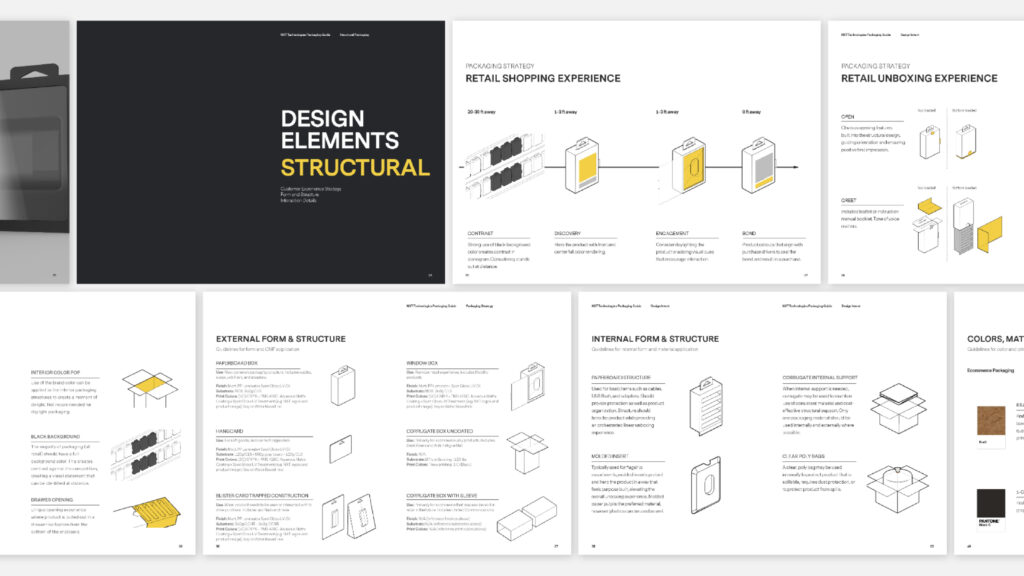
Every organization has different needs, but comprehensive packaging guidelines typically include the following components:
Brand Personality & Design Principles
Strong guidelines document not only the rules, but the logic behind them. Brand personality and design principles give teams a framework for making decisions when an exact scenario has not already been documented.
These typically define:
- Core brand personality attributes
- Design principles derived from those attributes
- How principles translate into physical product and packaging decisions
This gives teams and vendors a shared reference for decisions that fall outside specific documented cases.
Packaging Experience Strategy
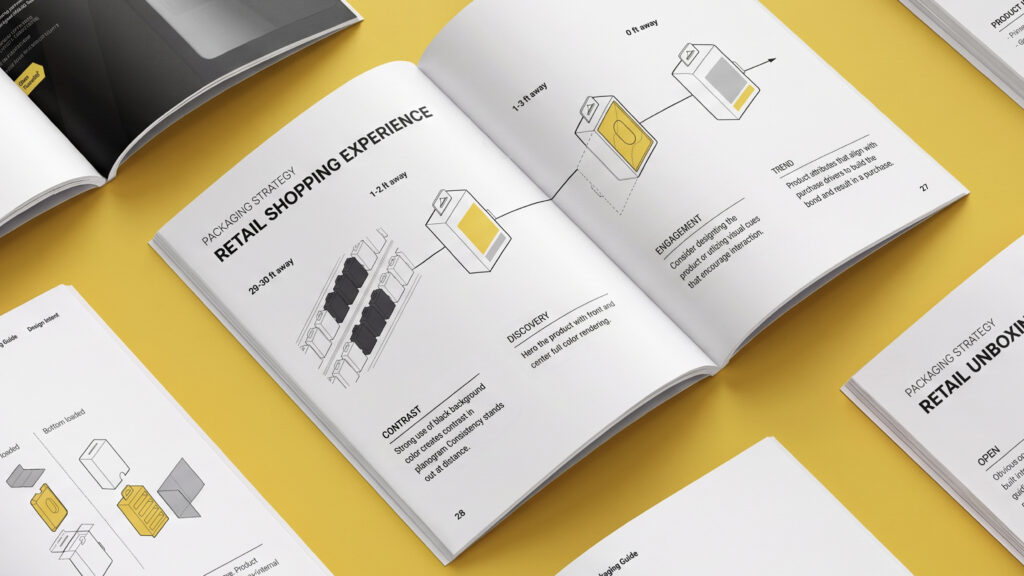
Define the experience the packaging should create across discovery, purchase, opening, use, and disposal, not simply how it should look on shelf.
This typically includes:
- The intended feeling or response upon encountering the package
- How structural and graphic design work together to support that experience
- How the experience carries through from shelf or shipment to unboxing
Brand Usage
Set clear standards for logo placement, minimum sizing, clear space, approved lockups, and improper usage.
Color And Typography Systems
Identify approved color palettes and production specifications including Pantone and CMYK.
Typography standards should define hierarchy, font families, sizing, spacing, accessibility, and usage across different package formats.
Layout Rules
Consistent layout systems help shoppers quickly identify products while simplifying future packaging development.
Guidelines typically define:
- Information hierarchy
- Grid systems
- Front, back, and side panel organization
- Required messaging
- Regulatory zones
- Safe areas
Interaction Details
Define how users are expected to handle, open, access, reclose, store, and dispose of the package.
This typically includes:
- Opening sequence
- Closures and access points
- Interaction cues
- Reclosure or reuse requirements
- Accessibility considerations
- Disposal or recycling communication
Product Architecture
As portfolios grow, packaging must communicate both individual product differentiation and the relationships across the broader family.
Packaging guidelines define:
- Product families
- Variant systems
- Naming conventions
- SKU hierarchy
- Sub-brands
- Limited editions
- Portfolio organization
This creates consistency across product lines while allowing room for future growth.
Demonstration Design
Closely related to product architecture, demonstration design defines how products are visually shown.
Guidelines should define standards for:
- Family demonstrations, showing multiple related products together
- Individual demonstrations, showing a single product on its own
Imagery And Photography
Visual assets should follow consistent standards for:
- Photography
- Product renders
- Contextual imagery
- Illustrations
- Icons
- Background treatments
When brands use CGI as part of their workflow, guidelines can also establish standards for digital assets used across ecommerce, retail, and marketing.
Claims, Compliance, And Localization
Packaging guidelines should document how required claims, certifications, legal copy, and regulatory information are displayed.
For brands selling across multiple regions, this typically also includes:
- Dual-language or multi-language layout standards
- Sizing and positioning rules for translated text
- How translated content is prioritized alongside primary-language copy
The objective is to accommodate mandatory information without allowing regulatory, legal, or localization requirements to destroy the hierarchy and consistency of the system.
File Standards And Naming Conventions
Production-ready documentation should include:
- File naming standards
- Folder organization
- Version control
- Editable artwork
- Production-ready exports
- Vendor deliverables
File governance is part of packaging governance. Consistent naming, version control, folder structures, and handoff standards reduce errors and make approved assets easier to locate and reuse.
Dielines And Structural Documentation
Structural documentation turns the design system into something vendors can reproduce consistently.
This documentation often includes:
- Approved dielines
- Bleeds
- Safe zones
- Fold locations
- Glue areas
- Material specifications
- Print finishes
- Manufacturing notes
In-Pack Communication Standards
For products that include instructions, warranty materials, inserts, quick-start guides, or other in-pack communication, the packaging system should extend to those materials as well.
This typically includes standards for:
- Manual and insert layout
- Typography and information hierarchy
- Illustration style and usage
- Quick-start guide structure
- Warning and caution placement
- Warranty and legal information
- Icons and instructional graphics
- Multi-language requirements
- Print specifications and material requirements
Packaging Guidelines Become More Valuable As Brands Scale
The value of packaging guidelines increases disproportionately as the organization scales.
One guideline may influence hundreds or thousands of future executions. What works for a handful of SKUs often becomes difficult to manage across expanding product portfolios, multiple business units, or global manufacturing partners. Without a documented system, small inconsistencies accumulate over time, creating unnecessary complexity for both internal teams and vendors.
Well-developed packaging guidelines give organizations a common language for decision-making. They make it easier to launch new products, onboard new suppliers, maintain quality across print runs, and preserve brand consistency as packaging evolves.
For large organizations, packaging guidelines are an operational tool that supports long-term growth.

Building Packaging Systems That Scale
Sprout develops packaging systems designed to survive scale: new SKUs, new categories, new teams, new vendors, and changing business requirements.
Our work spans structural packaging, graphic packaging, product architecture, production documentation, and the standards that connect them into a cohesive system. The goal isn’t simply to create a successful package today, but to establish a framework that supports future products, teams, and vendors.
For Staples, Sprout developed packaging systems that could be applied across thousands of SKUs and multiple product categories, creating consistency without forcing every product into an identical template.
A guideline only creates value if teams can use it.
That is why implementation is part of the work. Sprout facilitates cross-functional workshops, trains internal teams and production partners, and helps establish the processes needed to apply standards consistently. These sessions help teams understand not only what the guidelines are, but why they exist and how they should be applied throughout the development process.
In addition, we provide training around print production practices, helping ensure packaging designs flow smoothly from creative intent through manufacturing. By creating alignment between internal teams and external vendors, organizations reduce rework, improve production quality, and build packaging systems that are easier to scale.
Strong Packaging Systems Don’t End With Design
A successful package is only as strong as the system that supports it.
Clear packaging guidelines turn individual design decisions into a repeatable system. They help teams launch new products faster, reduce unnecessary interpretation, maintain production quality, and preserve brand consistency as the organization grows.
The objective is not to document every possible future package. It is to establish principles, rules, tools, and governance that allow teams to make the right decisions when new situations emerge.
Sprout helps organizations build packaging systems that connect strategy, structure, graphics, production standards, training, and governance into a framework designed to scale.
Managing a growing packaging portfolio or preparing for broader scale? Sprout can help establish the guidelines, tools, and governance needed to keep teams and vendors aligned as the business grows. Connect with our packaging team to start the conversation.