A strong product design brief is the foundational infrastructure of successful product development. It is not a bureaucratic formality; it is a live alignment tool that translates business strategy, user pain points, and technical constraints into a single, unified blueprint for product, design, and engineering teams.
When projects skip this step or rely on loosely defined requirements, momentum stalls. Misalignment surfaces as disjointed concepts, feedback loops become cyclical, and engineering teams are forced to interpret product intent rather than executing with precision against it.
A high-fidelity brief eliminates ambiguity, creates deep cross-functional velocity, and ensures that you are building the right solution to the right problem from day one.
Below, Sprout’s product development team outlines the anatomy of a product design brief, how to build one sequentially, and an actionable, production-ready template to streamline your next initiative.
What Is A Product Design Brief?
A product design brief is a foundational document that defines the intent, requirements, and constraints of a product before design and engineering begin.
It connects business strategy, user needs, and product direction into a single reference point that guides decision-making throughout development.
It is not the same as a marketing brief, creative brief, or full product requirements document. Those often focus on messaging or technical specifications in isolation. A product design brief sits earlier in the process and defines what is being built and why, before execution details take over.
It acts as the bridge between idea, strategy, and development.
Why A Strong Product Design Brief Matters
Most inefficiency in product development comes from misalignment, not execution.
A strong brief ensures teams are solving the same problem from the start. It defines the direction early, before assumptions begin to diverge across disciplines.
It improves collaboration between product, design, engineering, and external partners by creating a shared understanding of goals and constraints.
It also reduces rework during concept development and prototyping by clarifying what success looks like before design decisions are made.
At Sprout, we use the product design brief as the starting point for product development. It connects user insight, business intent, and technical feasibility into one structured direction.
What To Include In A Product Design Brief
A strong product design brief connects strategy to execution. It gives teams enough clarity to move quickly while still leaving space for design exploration.
1. Project Overview
Start with a clear summary of what is being built and why.
Include what the product is, what stage it is in, and why the project is happening now. This gives immediate context for all stakeholders and sets the foundation for the rest of the brief.
2. The Problem To Solve
Define the problem before any solution is discussed.
This should describe the user pain point, unmet need, or market gap the product addresses, and why it matters to the business.
A clearly defined problem prevents teams from optimizing the wrong solution.
3. Target User
Define who the product is for and how it will be used.
Include user profiles, key use cases, environments, and behavioral context. Where relevant, include ergonomic or functional considerations that may influence form or function.
The clearer the user definition, the more grounded the design process will be.
4. Business Goals
Define what success looks like from a business perspective.
This may include financial targets, volume, category entry, differentiation, premium positioning, portfolio expansion, or launch timing.
These goals ensure design decisions stay aligned with broader business priorities.
5. Product Requirements
Translate intent into clear functional expectations.
Include features, performance criteria, usability requirements, and any safety, regulatory, compliance or manufacturing constraints.
This section reduces ambiguity later in development and helps prevent scope drift.
6. Brand & Design Direction
Define how the product should feel and express the brand.
Include visual tone, CMF direction, reference products, and any relevant design language.
This section provides direction without over-defining the solution too early.
7. Technical Constraints
Define the real-world limitations shaping the design.
This includes materials, manufacturing methods, cost targets, packaging considerations, and timeline constraints.
Strong product design happens within constraints, not after them.
8. Deliverables
Define what the team is expected to produce.
This may include sketches, CAD, prototypes, CMF direction, engineering support, and presentation-ready visuals.
Clear deliverables create alignment on scope and expectations.
9. Timeline & Milestones
Define how the project will move forward.
Include key milestones, review stages, approval points, and launch deadlines.
This ensures feedback happens at the right time, not after decisions are already made.
10. Stakeholders & Decision Makers
Define who is involved in the process and how decisions are made.
Include reviewers, final approvers, and how feedback should be consolidated.
Clear ownership prevents conflicting direction during development.
How To Write A Product Design Brief
A product design brief should be built in sequence.
Start with the problem, not the product. Then define the user and context of use so the team understands who they are designing for and how the product will function in the real world.
Next, align on business objectives so decisions can be evaluated against strategic intent. Once that is clear, introduce constraints including cost, manufacturing, and technical limitations.
From there, define and prioritize requirements based on both user and business needs. Add brand and design direction to establish intent without over-prescribing solutions.
Finally, define deliverables and timelines so expectations are clear and the team can move into development with structure.
Before design begins, the brief should be reviewed with all stakeholders to ensure alignment and remove conflicting interpretations.
Product Design Brief Template
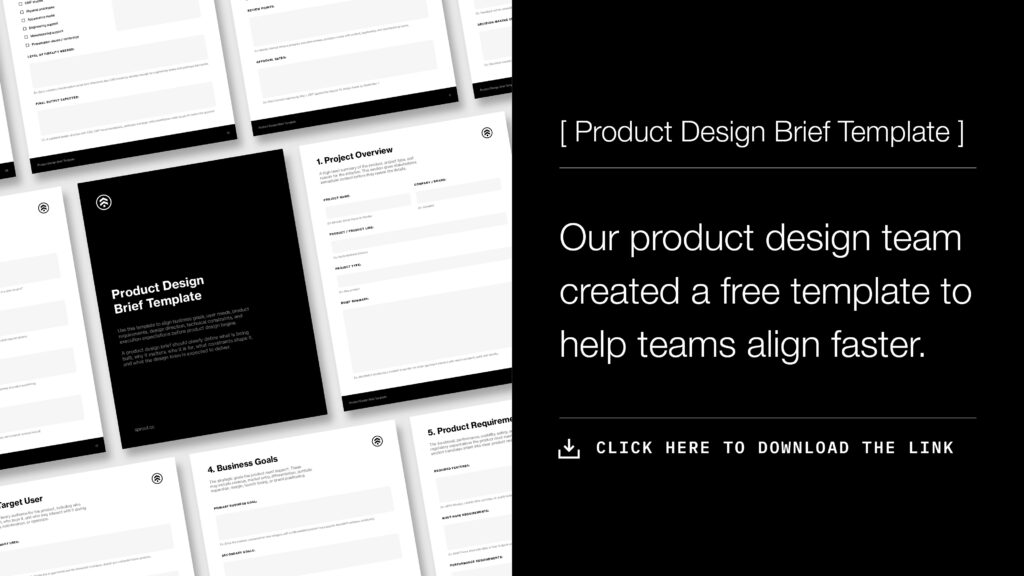
Our design team developed this template to help teams align quickly and consistently. It brings together the key components of a strong product design brief in a structured format that reduces ambiguity and supports faster decision making.
→ Download the template to build your product design brief and streamline your next project.
Common Mistakes That Weaken A Product Design Brief
Most weak briefs fail due to lack of clarity, not lack of information.
Common issues include unclear problem definition, feature-driven thinking instead of outcome-driven thinking, missing constraints, or undefined users.
Another common issue is unstructured stakeholder input that creates conflicting direction.
Finally, treating the brief as a static document rather than an evolving alignment tool reduces its value throughout the project.
When To Bring In A Product Design Partner
Not every product brief needs to be perfect before you start designing, but there are clear points where external input adds meaningful value.
A product design partner is especially useful when early direction is unclear, when stakeholders are not fully aligned, or when an idea needs to be translated into something that is both strategically sound and technically viable. In these situations, the brief becomes less of a formality and more of a working tool for alignment and decision-making.
It can also help when multiple disciplines need to come together early in the process. Usability, manufacturability, and brand expression often conflict when they are developed in isolation. A design partner helps resolve these tradeoffs earlier, before they become costly downstream changes.
Alignment Starts Before Design Begins
Ultimately, a product design brief is less of a static corporate document and more of an interactive alignment mechanism. The quality of your brief mirrors the quality of the final product. By investing the time to define constraints, map the ecosystem, and clarify the core user problem upfront, you eliminate late-stage revisions, protect your development budget, and construct a much faster path to market.
If your team is balancing complex multi-disciplinary design loops, navigating tight regulatory frameworks, or looking to translate early strategic goals into an actionable, manufacturable hardware portfolio, connect with Sprout’s integrated industrial design and product development team.