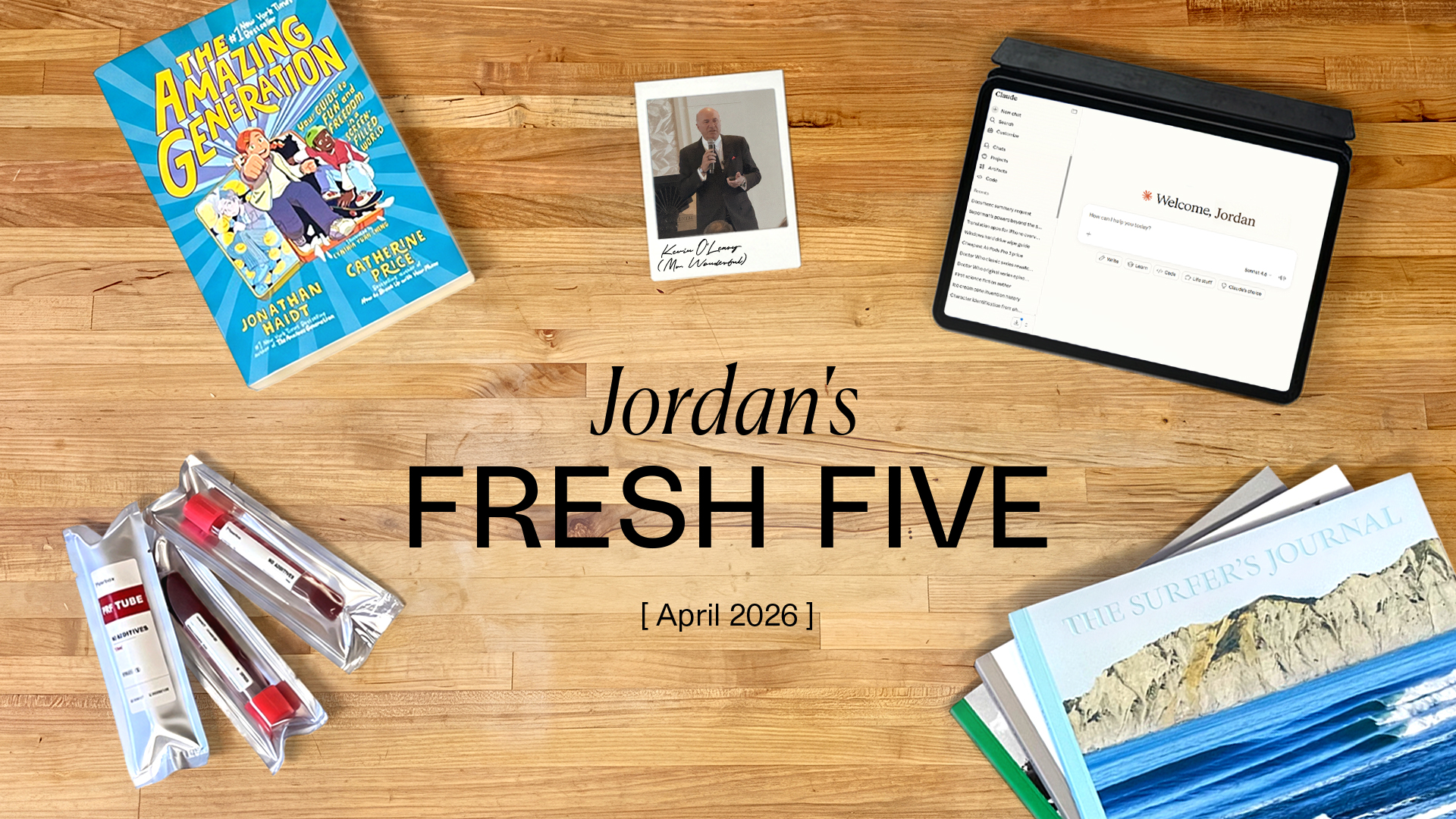
Sharing another round of things shaping how I’m thinking lately.
Each one is a reminder to stay curious, pay attention to the details, and find inspiration in the everyday.
1. Print: The Surfer’s Journal
The Surfer’s Journal reads more like a book of art than a traditional magazine. The photography, the places, the people, and the stories are all deeply considered, creating something you spend time with rather than move quickly through.
As a lifelong surfer, I genuinely look forward to each issue. There’s an anticipation to it that feels increasingly rare, a pause in the constant flow of digital content.
I have a growing collection at my beach house in Maine, where they’re always within reach and meant to be shared. It’s the kind of work that holds its value not just in the moment, but over time, continuing to inspire long after the first read.
2. Listening: Kevin O’Leary at The Quin
I recently had the chance to hear “Mr. Wonderful” Kevin O’Leary speak, sharing perspective from decades of building and investing across rapidly changing markets. What stuck with me most was how consistently his thinking comes back to execution, speed, and simplicity.
A major theme was how direct-to-consumer shifts during the pandemic reshaped business fundamentals. Companies that owned the customer relationship saw significant margin expansion, and even large brands like Nike accelerated their move into direct sales, fundamentally changing how they operate.
He also highlighted how quickly behavior can shift when it has to. During COVID, 140 million Americans over 55 adopted digital tools, creating a new digitally fluent customer base almost overnight.
Across examples, the message was consistent: speed to market and customer acquisition now often matter more than traditional protection mechanisms. Brand trust, clarity, and distribution are becoming the real defensible advantages.
Another clear takeaway was how few companies ever reach early traction. Getting to the first $1M in revenue remains one of the strongest signals of product-market fit, but only a small percentage of startups get there. From there, execution becomes the real differentiator at every stage of growth.
He also made it clear that AI is no longer optional. It’s now expected as part of core business infrastructure, especially in customer acquisition and operational efficiency. Alongside that, he framed what I’d call his core operating principles: execution, speed, simplicity—and a fourth that often gets overlooked but may be the most important in practice, judgment.
What stayed with me most was how consistently all of it ties back to decision-making under pressure, and how much of success still comes down to getting the fundamentals right as everything around them accelerates.
3. Reading: The Amazing Generation: Your Guide to Fun and Freedom in a Screen-Filled World by Jonathan Haidt and Catherine Price
Though aimed at tweens and early teens, this is a book I’d strongly recommend for parents to read alongside their children, or anyone thinking about how technology is shaping childhood and the next generation more broadly.
It builds on the research and ideas introduced in The Anxious Generation, Jonathan Haidt’s widely discussed work on how smartphones and social media are impacting adolescent mental health and behavior. I’d also recommend reading that one alongside it for broader context.
What makes this one different is the shift in tone. It moves from diagnosis to perspective, stories, and practical ways of rethinking how kids engage with technology. Rather than leaning into fear, it’s more about awareness, choice, and redefining what “normal” looks like.
The book is accessible for younger readers, while still carrying real weight for adults navigating when and how to introduce devices in a more intentional way. At its core, it’s about helping young people take ownership of their digital lives and find more freedom, creativity, and joy offline.
On a personal level, this topic has been heavily on my mind as a parent. We were navigating parenting our first teen through COVID when so much of life moved online. She’s 18 now, very social and grounded in the real world, but like many in her generation, she still feels the pull of constant connection. Now with my 13-year-old, we’re being more intentional about how screen time is balanced and shaped day to day.
4. Health & Wellness: Personal Biomarkers
There’s been a noticeable shift toward more continuous, data-driven approaches to understanding personal health, moving from one-off annual checkups to more layered biomarker testing and tracking.
Tools like WHOOP, Function Health, and other emerging platforms are making it easier to access a much wider range of health signals, from recovery and sleep to deeper metabolic and physiological markers. I’ve been on WHOOP since the early days, and what started as a single system has expanded into a broader curiosity around how different platforms surface different layers of information about the body.
Alongside wearables, I’ve also started personally doing more formal biomarker testing, working with a doctor and using insurance-covered labs where possible, with a plan to repeat this bi-annually to build a clearer baseline over time rather than relying on one-off snapshots.
What’s been most interesting is the level of insight you can actually get from this kind of data. Depending on what you’re trying to understand, whether it’s energy, recovery, performance, or longer-term health risks, these tests can surface patterns and signals that you would never normally see in day-to-day life. There’s something fascinating about being able to actually measure what’s going on internally, rather than guessing.
The key is figuring out what you want out of it. It really depends on where you are in life, what you’re curious about, and what questions you’re trying to answer about your own health. When approached that way, the data becomes much more useful, because you’re not just collecting information, you’re actively trying to learn from it.
At the same time, there’s a balancing act emerging. More data doesn’t automatically mean better decisions, and in some cases the volume of information can become overwhelming if it’s not grounded in clear intent.
Overall, it feels like this space is moving toward personalization over standardization, where the value isn’t just in the biomarkers themselves, but in knowing what to measure, when to measure it, and how to actually use what you find.
5. Technology: Claude Opus 4.6
Over the past month, I’ve been experimenting with Claude across its different models, with Opus 4.6 emerging as the clear favorite in my workflow. What’s stood out is how it performs as a thinking partner across more complex, layered work.
Historically, ChatGPT has been my go-to AI tool and something I’ve used throughout the day for almost everything, from work and client projects to personal planning.
Where Opus 4.6 stands out is in that deeper, more considered layer of work. It’s especially strong at organizing complex inputs, refining strategic narratives, and helping translate messy or early-stage thinking into clearer frameworks.
Within Sprout, we’ve been exploring AI since the beginning with a fairly simple point of view: they’re not just productivity tools, they’re creative and operational partners when used correctly. That lens has shaped how we’ve been applying Claude across the studio in different ways from early concept exploration to experimenting with custom code and automations.
One of the clearest differences we’ve noticed is consistency. ChatGPT is still incredibly useful, but at times it can ‘hallucinate’ or lose constraints between prompts, which requires more frequent correction or re-grounding. Claude, in our experience, is more stable in maintaining parameters across longer, multi-step work. The tradeoff comes down to how usage scales. As workloads get heavier, with longer threads, more complex outputs, and more iteration, the cost increases quickly, especially when working in more advanced models like Opus. We found ourselves having to increase our subscription repeatedly to avoid hitting constraints and interrupting workflow, with cost escalating faster than other tools we’ve used.
In this rapidly evolving space, the value is increasingly in understanding where each AI tool fits within a workflow, and being intentional about how you apply them.
Right now, Opus 4.6 is the model I reach for when the work requires depth, structure, and sustained reasoning across multiple steps.